Posted on Leave a comment

It’s time for hooves and bottoms again!

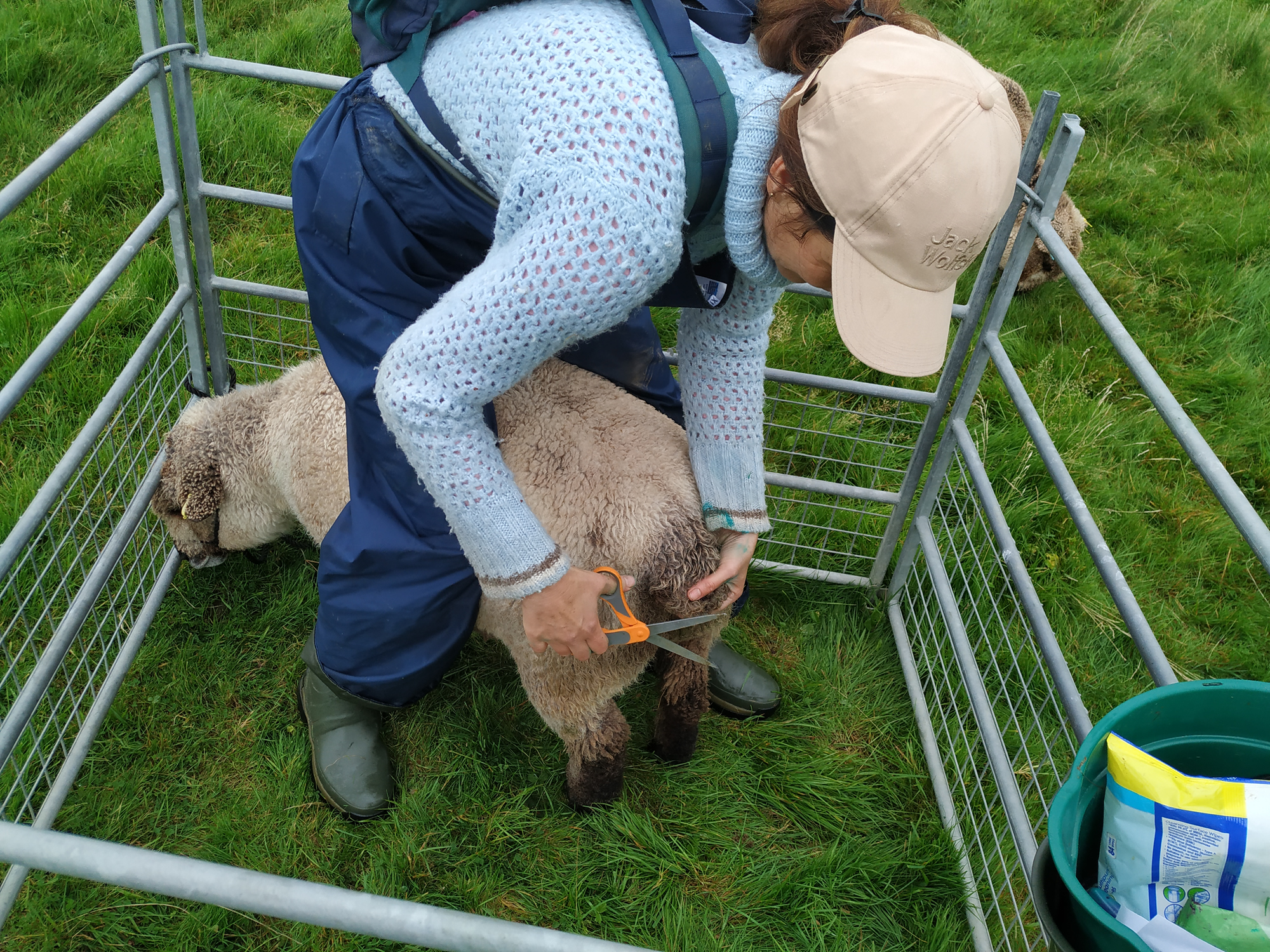
nicole doing sheep bottom

Every three months we give our sheep a general MOT, this means checking their teats, checking (and trimming if necessary) their hooves, trimming the wool around their bottoms and trimming the wool around their eyes.  Out of all these jobs, probably the most important is trimming the wool around their bottoms (known as “dagging” in the sheep world).  Dirty wool can attract flies which can lead to flystrike which is a killer.

I should mention at this point, back in the olden days when we first had sheep, the days leading up to doing the MOTs would cause me palpitations, (not Adrian, he is the laid back sort rather irritatingly).

Just getting our sheep into a pen, let alone doing all the necessary tasks could be fraught with disaster.  In fact it was due to many mishaps; sheep refusing to be penned up, us chasing sheep around the paddock, our inability to “tip” them once we had got them into a pen, us being stood on by sheep, us ending up flattened by a sheep, the list goes on … but anyway, all these set backs did have a positive outcome, it made us quickly rethink our sheep handling strategy.

One frosty day whilst nursing a squashed toe after being stood on yet again by one of our larger ladies I had a rare light bulb moment.  I remembered how our mentors were always leading their sheep around with halters.  They are great show enthusiasts so had trained their flock to be halter trained.  I wondered if we could do the same and so make life easier for ourselves when it came to doing their health checks.  We weren’t interested in showing our sheep, but the idea of a docile sheep trotting after us on a lead rope seemed very appealing not to mention practical.  I particularly like the idea of not having to “tip” a sheep again (it’s nigh on impossible unless you have cracked the technique and I clearly hadn’t).  The vision I had in my mind was to be able to work on the sheep whilst it was standing up, tied to a railing by a lead rope rather like a horse.

A training plan started to form in my mind based on a mixture of Cesar Millan’s and Monty Robert’s “whispering” approach.  I would use psychology, patience and bribery in the form of sheep nuts.

I ordered some halters and as soon as they arrived I got to work.  I set up a largish pen in the paddock with a smaller pen inside, filled my pockets with nuts and off I went.

It took me a while (about a week) to complete “phase one” for the sheep to start coming to me and letting me put the halter on.  The next thing I did was gently walk them around the pen (phase two).  If they got spooked I let go of the halter.  If they didn’t I led them into the smaller pen.  Several weeks of training later and little by little I managed to get each and every one of our sheep (nine to be precise) used to the halter, and eventually I was able to tie them up in the smaller pen and actually do some work on them, hurrah!!  It was a huge turning point for us in our sheep management because now our sheep were “tame”, they trusted us and so we felt a huge weight had been taken off our shoulders.

If we needed the vet we no longer worried about having to chase a sheep around just to get it into a pen, if we needed to move them to another field we simply haltered them or better still, called them and they followed us.  Rounding up our flock became a pleasant and fun thing to do instead of anxiety provoking and as a result our flock became relaxed whenever we were around them.  We were happier and so were our flock.  And the best part of the “training” programme was that we got to know our sheep as individuals with unique personalities.  We noticed that Sparkle makes funny grunty noises when happy or excited, we noticed that Selene has a particular tickle spot on her back, we noticed that Sarka was very shy and timid and needed extra time to learn to trust us.  We learned so much that winter, and mostly (I personally) learnt the art of patience (something hubs claims he’s yet to witness).

So, fast forward a few years, and after doing hundreds of MOTs, the three monthly ritual is a doddle compared to those early days.  That said, it is physically hard work and very time consuming.  Admittedly not helped by us expanding our flock somewhat.

So sometimes I have a little dream about owning a “Combi clamp”.  This is a gentle device for restraining a sheep and allows you to all those things that you need to do to: dose, inject, trim hooves, dag etc.  Although our sheep are easy as pie to handle, there is one thing I still struggle with; inspecting the back hooves.  I can trim bottoms till the cows come home, I can get stuck into the front hooves, but for some reason the back hooves are really tricky to do.  The sheep go into full on reflex mode when I so much as go near those hooves, to say they are not keen would be an understatement, they make it plain that it is the most irritating thing in the world.  I usually end up half underneath the sheep, resting their knee on my thigh and doing whatever needs doing between the hoof flicking out randomly and usually narrowly missing my nose.  As the sheep is only loosely restrained by the halter it can start to hop around a bit or worse, pull back towards me at which point I end up with a sheep’s bottom on top of my head.  Not a great experience all round and quite frustrating for both of us.  I’ve usually resorted to filling a bucket with carrots and letting them munch away while I quickly work on them but this is not ideal as I don’t always have carrots and I’m not keen on using treats as it makes the sheep hyper and they come to expect it and so become anxious, you have to be careful with how you use treats.
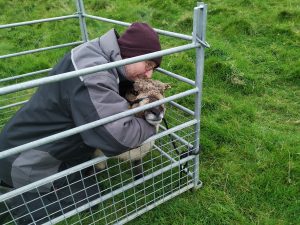
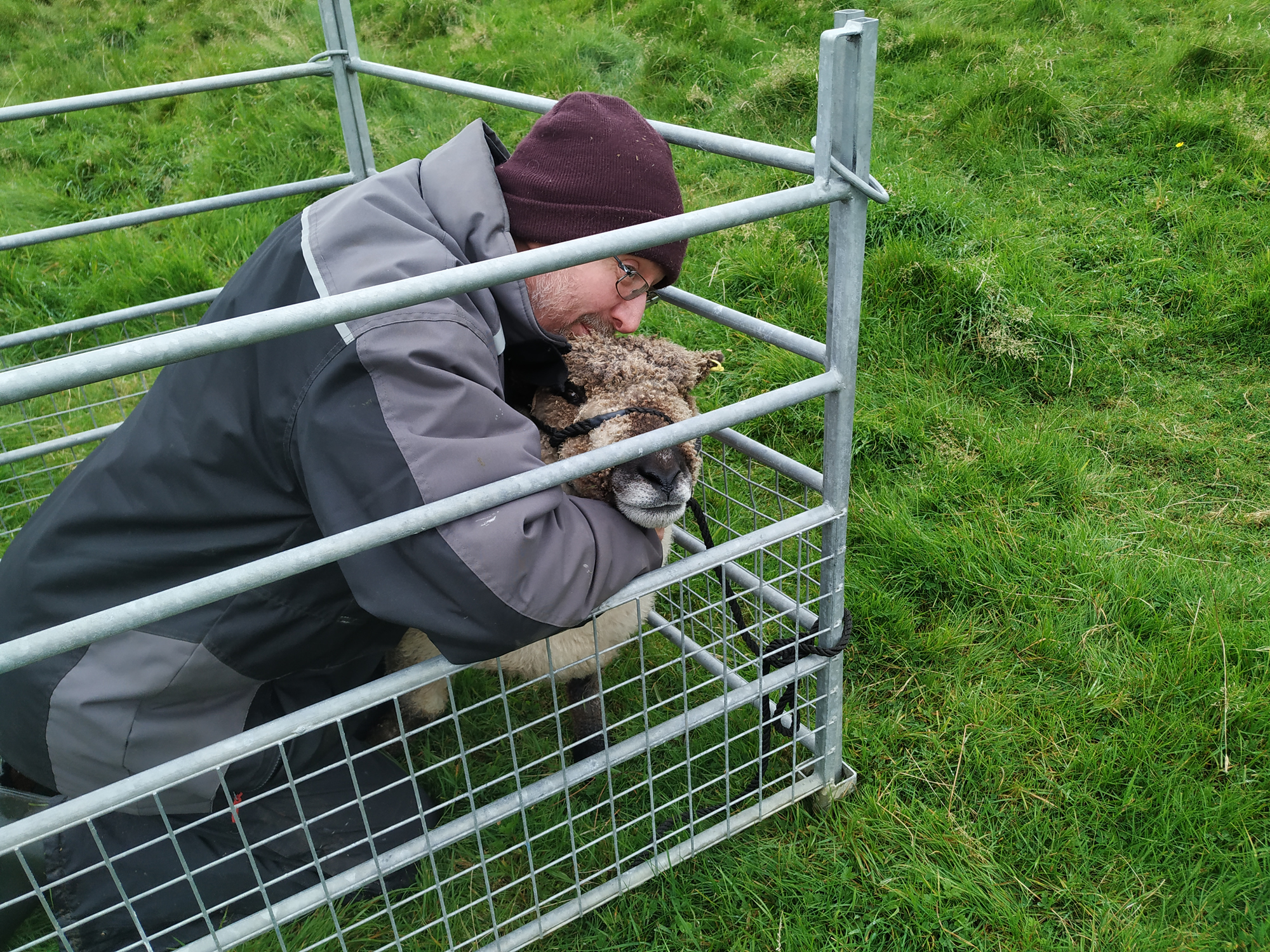
adrian being combi clampSadly Combi clamps are over £3,000 so that dream will remain a dream for the time being, meanwhile Adrian has offered to be my Combi clamp.  He makes a good one, he has a patented technique for keeping a sheep in exactly the right position while I can do their back hooves with ease. It is almost a blissful experience for all of us.  Part of the “Adrian technique” is to hug the sheep (so “clamping” it) whilst giving it a back scratch in just the right spot.  At this point they go into a kind of trance and start to gaze off into the distance, stretching their necks out and licking their lips.  I am happy because I can work on their hooves and no longer risk being decapitated, but Adrian is probably happiest of all because he hasn’t got to fork out £3,000 for a Combi clamp, well not for the moment anyway!
Posted on Leave a comment

Bim the Wonder Hen

Since June, Bim has been suffering from egg peritonitis (see swollen hen), a common condition in hens of all ages for which the prognosis is usually death.  Given this poor prognosis, we asked the vet (who happened to be here looking at a sheep) to have a look.  We fully expected we’d be putting her down (Bim that is, not the vet).  That said, swelling aside, she looked really healthy and so we all thought it might be worth trying again.

The vet agreed with our plan and left us with a course of anti inflammatories and antibiotics.

Bim fit and healthy again

Now, the problem is that while the antibiotics can deal with infections, they don’t really deal with the root cause (normally an egg yolk trapped in the abdominal cavity).  Nicole got on the internet to look for alternative approaches.  We also pondered alternatives to antibiotics – well we didn’t want to be giving her a jag every two days for the rest of her life.

We came up with an approach that incorporated a number of ideas.

  1. Warm baths with epsom salts.  These were mainly to help her feel better (we all love a good bath) as the condition causes a lot of swelling which looks pretty uncomfortable.  This is followed by a blow dry.  Bim loved this moving her wings to get an optimal flow.  We did this 2 or 3 times, basically while she was receiving her jags.
  2. A daily supplement which contains a mixture of garlic (two cloves per day), turmeric, black pepper, honey and olive oil.  Garlic and honey are natural antibiotics as well as being nutritious.  We also added to this a mineral boost containing calcium, probiotics and seaweed (you can buy this).
  3. A daily dose of Kali Phos, Bryonia and Hepar Sulf.
  4. Water – we added cider vinegar, multi vitamins and oregano.

The above sounds pretty complex, but it’s not really.  All the supplements can be mixed up and put in a bowl.  Bim, being the top hen, is always first to a bowl so, for us, it was fairly easy to make sure Bim got her “medicine”.  I say “us”, but it’s all down to Nicole really.

The net result of this is a that, for a time the swelling went down and Bim got back to being her old self.  When we wandered into the vet some time in July to pick up some sheep meds, the vet who had examined Bim happened to be standing there and asked how Bim was.  When Nicole said she had pretty much recovered, the vet’s jaw nearly hit the floor.  “That’s two miracles this year then” she said (or words to that effect).  I don’t think the vets can quite believe that Ymogen recovered from her broken jaw either (Ymogen’s Story).

Anyway, Bim was doing fine.  As she is about 5 years old, her laying days should be largely in the past.  However, a couple of weeks back, she went in to lay an egg.  Of course, no egg appeared, once again the yolk must have been “laid” internally.  Then she did it again and the swelling returned.  Despite all this, everything else about her was healthy.  You can tell when a hen’s time is close, they just stop.

Bim was starting to show signs of “stopping” in that she would still be in the hen coop at morning corn time.  We decided to give her another course of antibiotics.  At this time of year, laying drops markedly for all the hens.  The shortening days act as a kind of signal to stop laying.  The chances are Bim would stop laying and so might recover once any infection was treated.

The good news is that the swelling has gone again.  Bim has not had any garlic or natural supplements for a couple of weeks because she is now kind of wary of being caught again.  We are hoping that with the days shortening and her age, there will either be no more attempted laying for a while, or just sporadic attempts.  If she leaves enough time between eggs, then she should be able to reabsorb the internally laid yolk.

Nevertheless, she has survived much longer than predicted and we are now hopeful she’ll now make it through the winter.  After that, there’s a good chance she’ll be old enough not to lay any more and then could survive gracefully into old age.  Fingers crossed.


Posted on Leave a comment

Vera gets a touch of the itchies

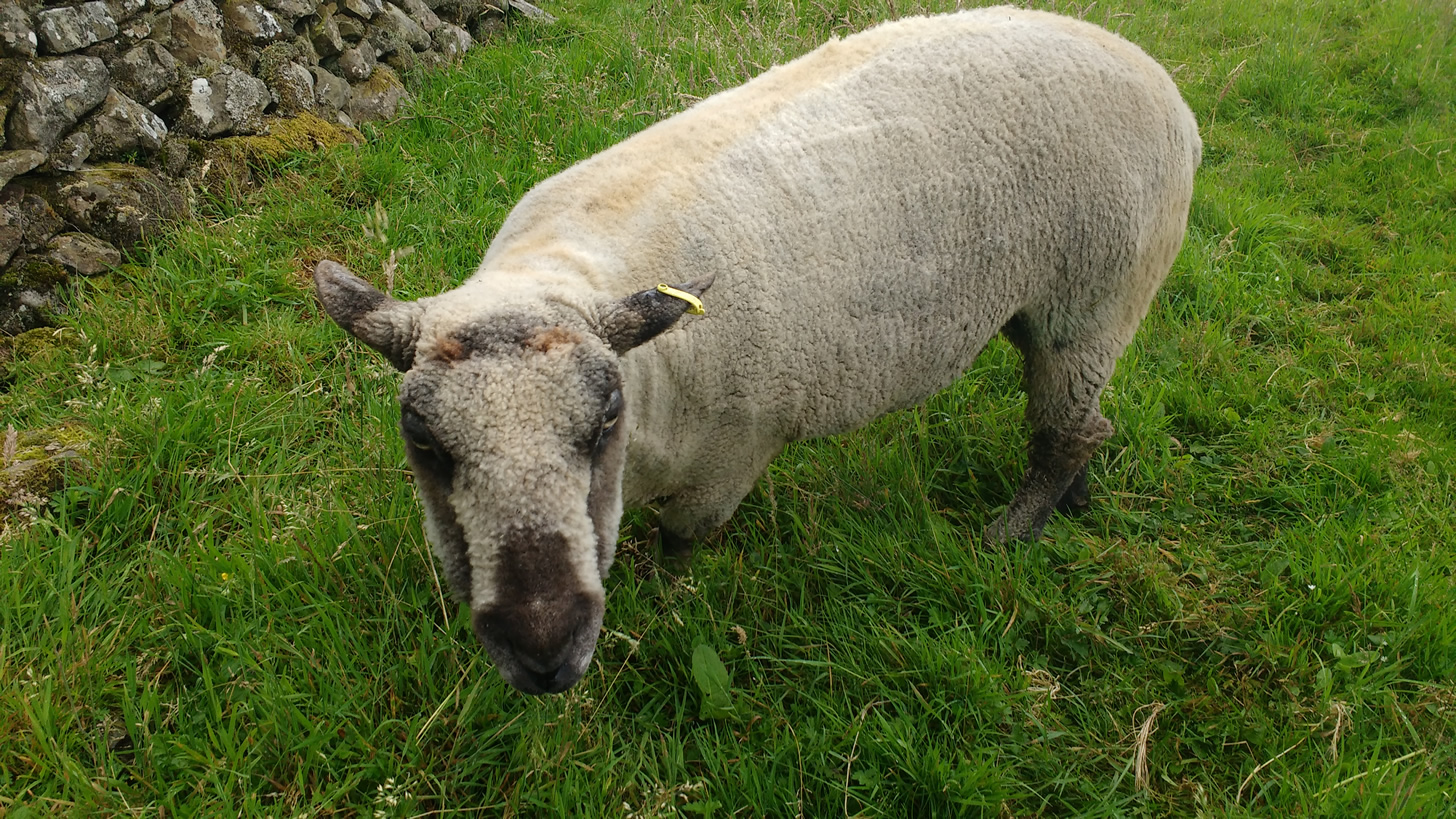
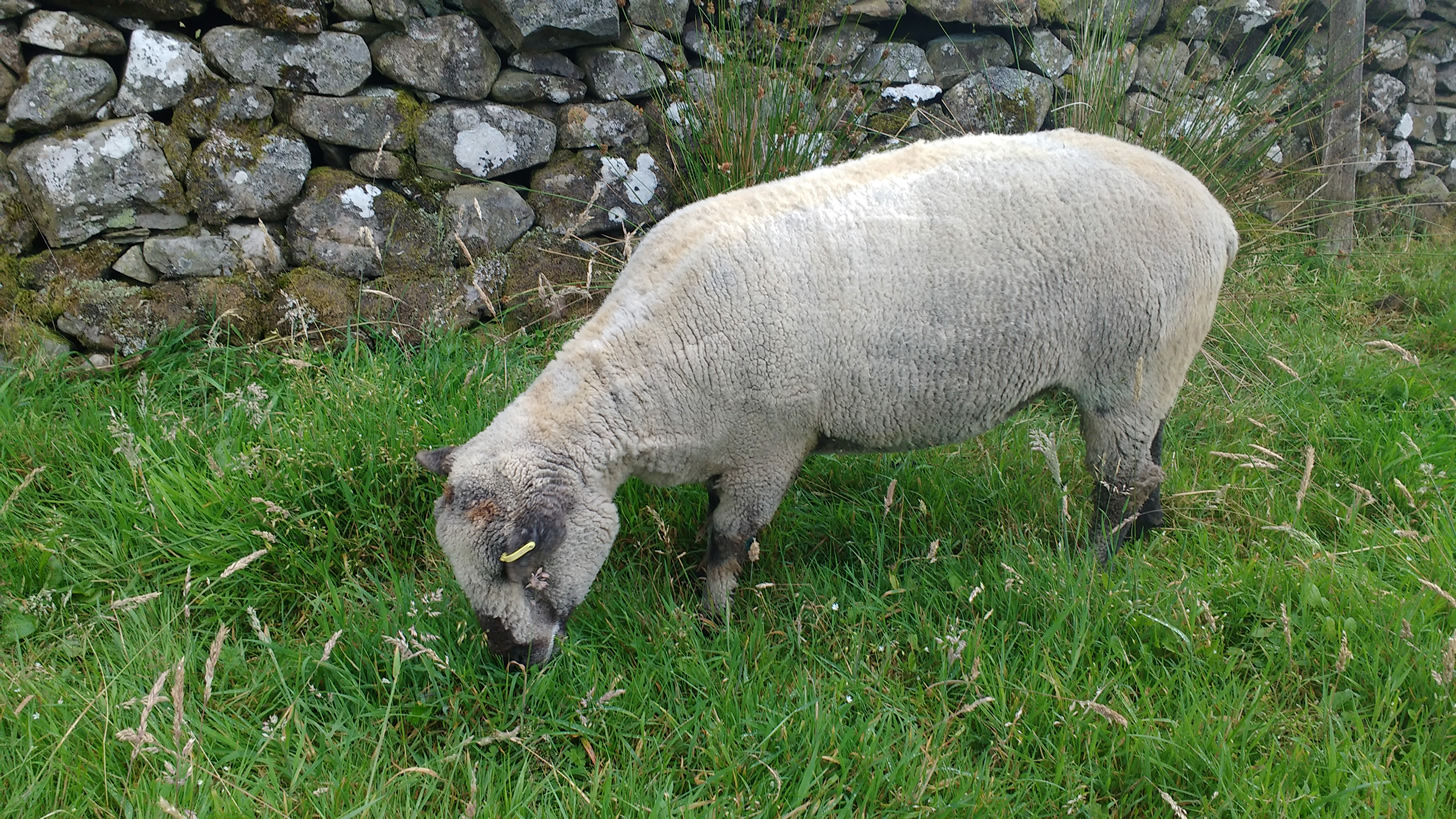
Vera, one of our Yorkshire lassies, has been on our radar for a while.  She’s one of three we brought over from a Yorkshire farm just after moving here and she has thrived, along with the other two Yorkshire lassies, Vi and Ursi.   Anyway, of late she has taken to sitting on her own in one of the shelters provided for them.

VeraVera has always had a bit of a tendency to do this, so no alarm bells were ringing.  Nevertheless, Nicole had checked her over just to be sure, and had found nothing wrong.  The last time a sheep went off on her own it was Scarlett whose ear tag had become infected.  But Scarlett also stopped eating and hung her head, (a sure sign something is wrong) whereas Vera could be seen chewing the cud and looking quite content as she sat in her shelter.

Yesterday was the year’s hottest day.  Even up here in the hills, it was pretty hot.  I was taking to dogs for their daily walk and I usually come back via the sheep just to give them a quick check and to say hello.  Vera was up and about, grazing with the others and I was about to head off back to the house when  I noticed her stamping her feet quite a lot and looking round.  This is the sort of behaviour that can be seen in early fly-strike, so I checked her.  No flies, eggs or maggots.  Then I noticed she had scratched her front leg raw.  Something wasn’t right.

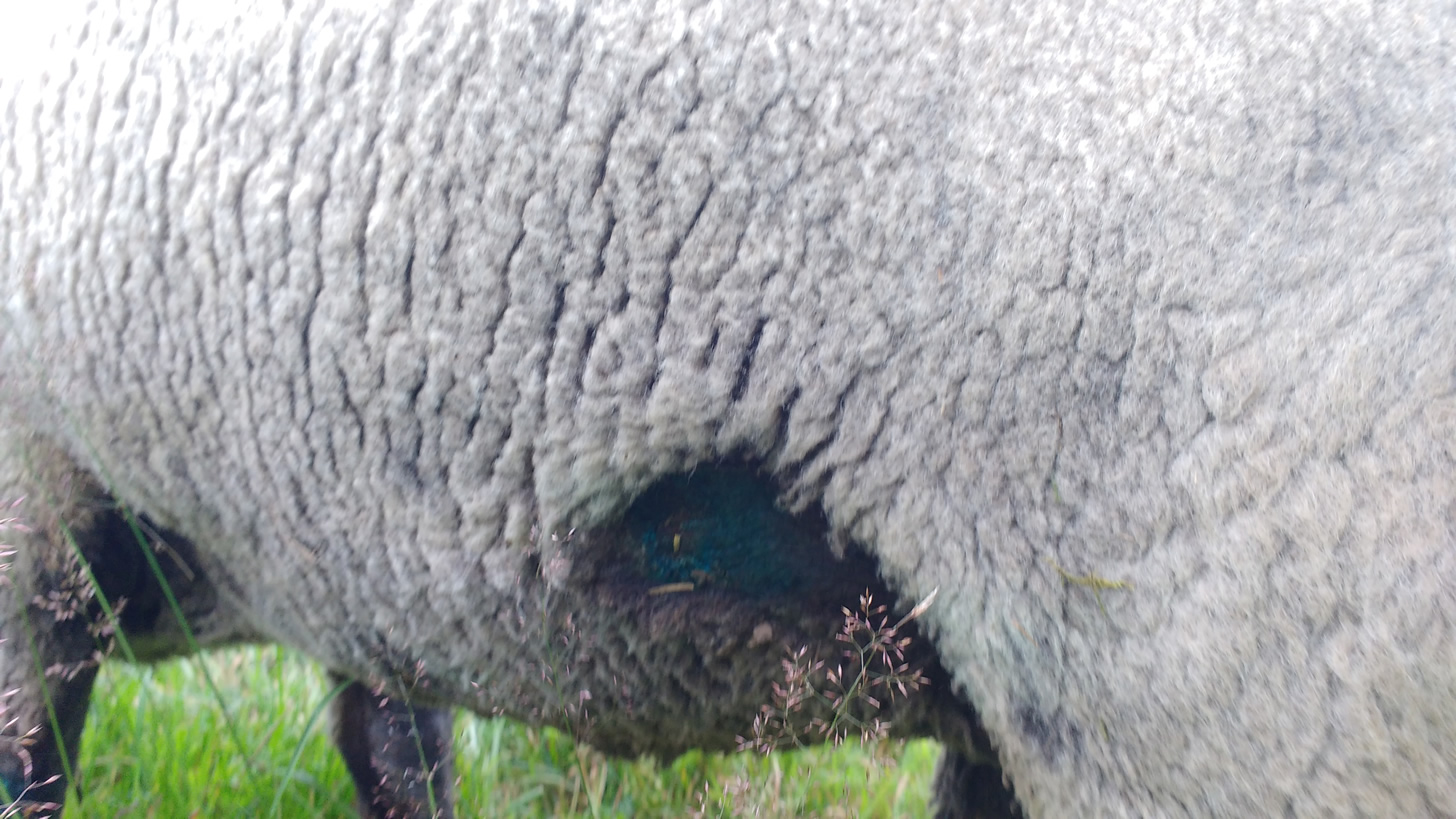
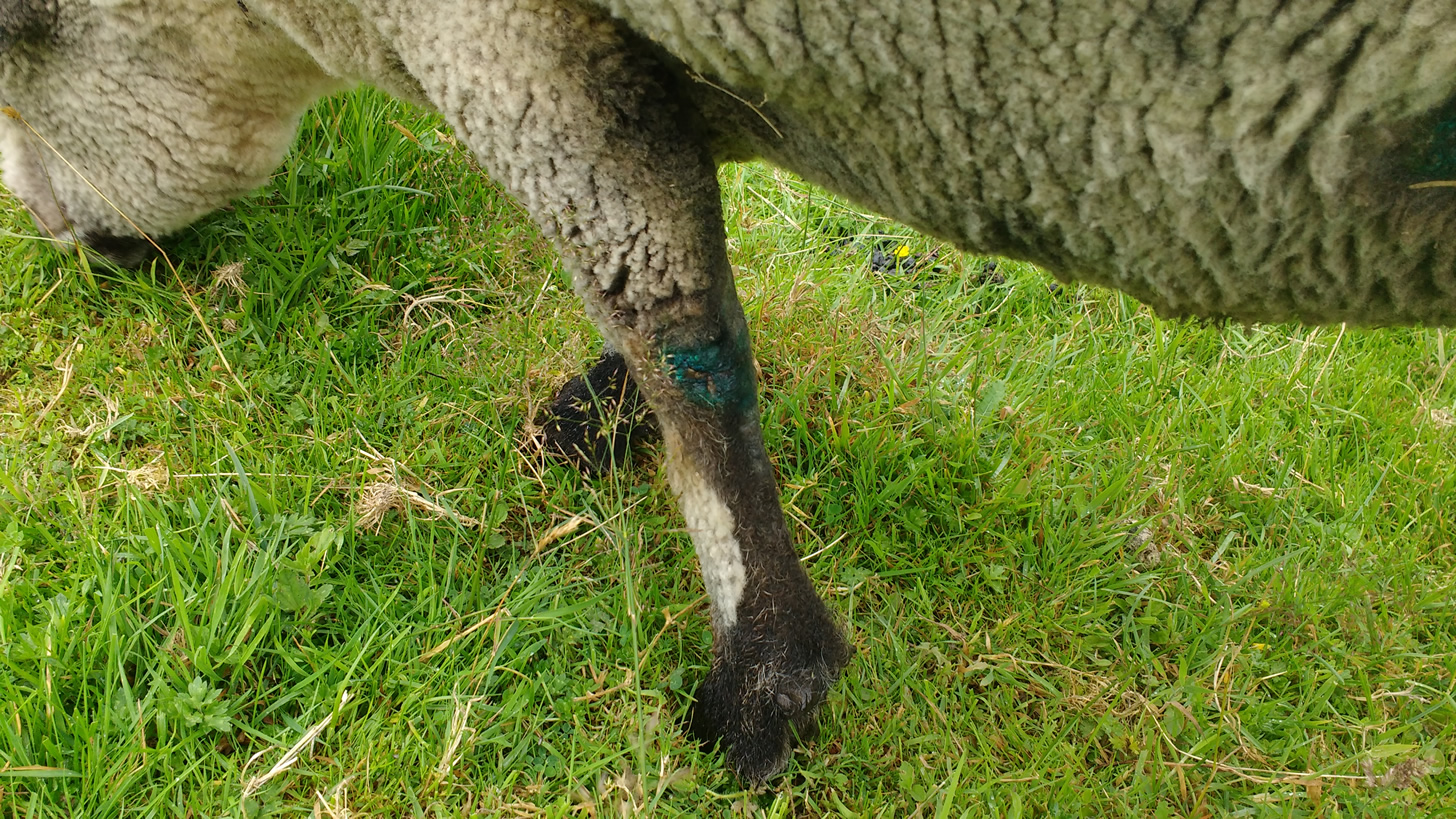
vera - leg wound
Vera’s leg wound (sprayed with blue spray)

I went and fetched Nicole and some iodine and we treated her wound.  Then Nicole checked for other wounds as all of a sudden Vera seemed to be very agitated.  We thought there had to be flies or maggots hiding somewhere.  After a careful inspection Nicole found that Vera’s skin, in the bare places where there is no wool, under her arms and the backs of her legs, seemed a bit inflamed and slightly hot to the touch, there were also some small crusty patches.  Our first thought was it might be “scab” however we haven’t had a case of “scab” before so we weren’t really sure.

So we duly called the vet and he came out and had a look.  After a careful examination he scratched his head and said he wasn’t really sure what it was, other than it wasn’t “scab”!  Basically, he said, it was in the wrong places for “scab”  and none of the other sheep were showing any signs, (“scab” is highly contagious).  Good and bad news – it wasn’t serious (good) but we were not sure what to do to treat it (bad)?

The swellings looked like they were a bit cracked and so could be infected so the vet gave her a mixture of steroids, anti-inflammatory and an antibiotic.   We wonder if she had had a bad case of midgie bites after shearing that hadn’t healed.  But we don’t know.  The vet thought it could be an allergic reaction to something she had eaten.  Maybe we will never know for sure.

We are monitoring her closely.  She looks a little better today (Friday), but she’s still a bit agitated and scratching and stamping her feet.  Fingers crossed it will clear up quickly.

Vera tucking in
Vera happily eating grass

And a quick update (Saturday).  She is out and about munching away happily.  There is still a bit of stamping, but nothing like two days ago.  It certainly looks like the really hot day aggravated things.  She is showing some photosensitivity which confirms the vet’s allergic reaction diagnosis.

To be honest, most of the sheep were finding it a bit hot, so it wouldn’t be surprising if it made the itchy parts worse.

Nicole is bathing the affected areas twice a day with chamomile tea.  We’re hoping that helps too.

Posted on Leave a comment

Flower bed cleared and replanted

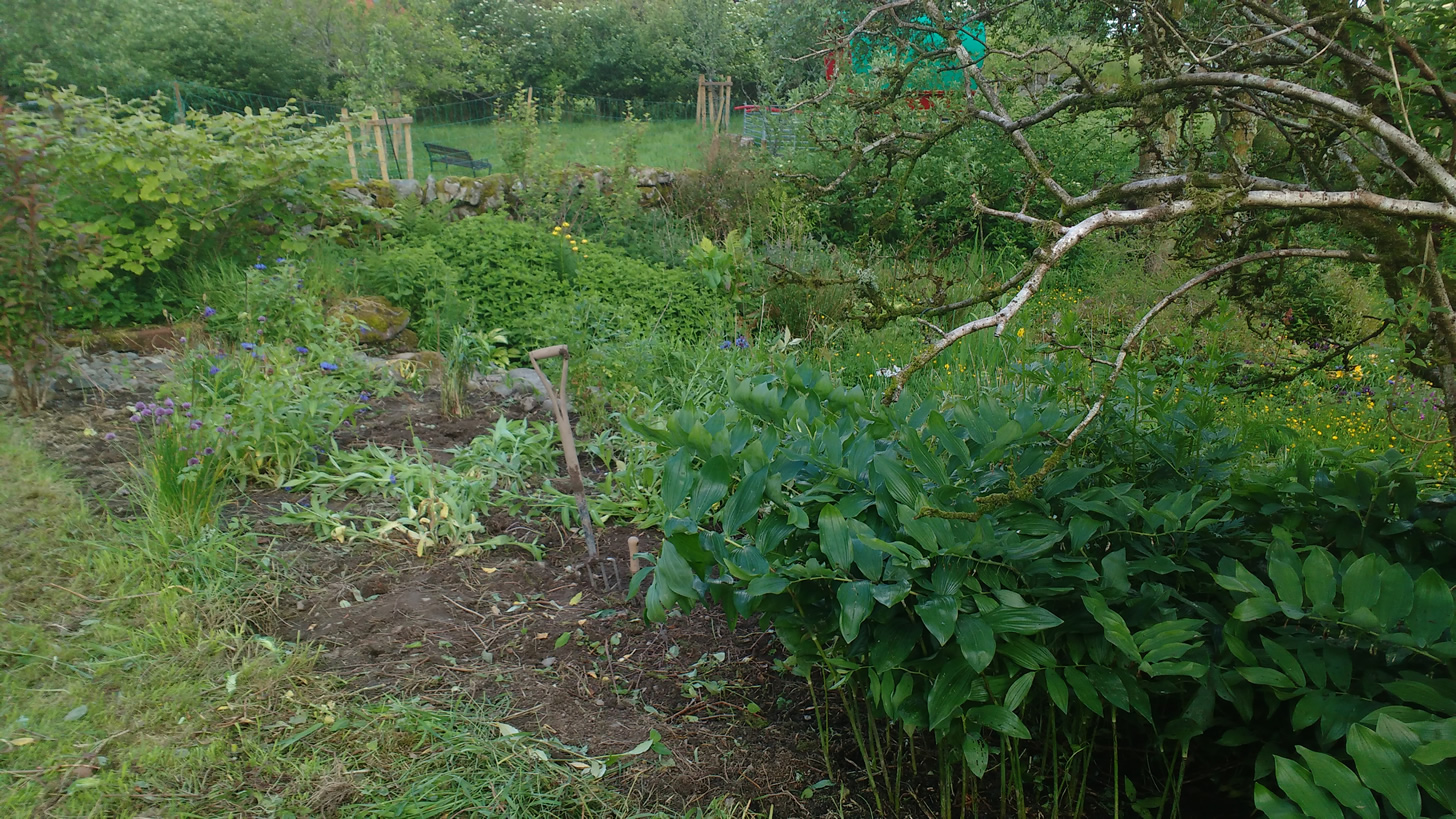
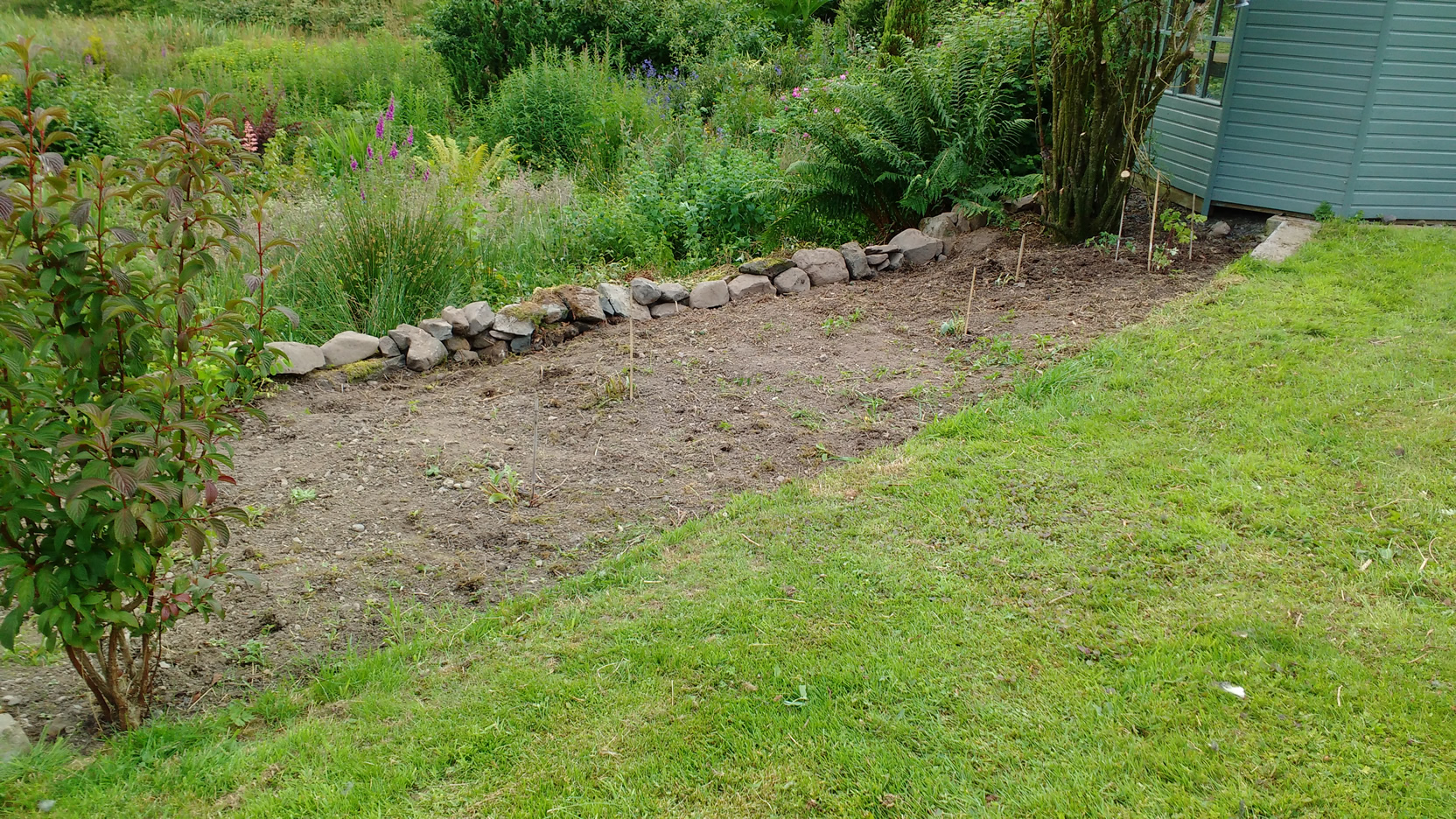
While the flower beds along the house and the meadow at the entrance are all looking great (summer at auchenstroan), the flower bed the other side of the lawn has always been a bit of an eyesore.  Most of the plants were, according to Nicole, a mish mash, in the wrong place; Crocosmia, Yellow Loosestrife, Solomon’s seal and Hostas.  In amongst these, Ground Elder, Bindweed and Willow Herb had taken over.  With me otherwise occupied trying to rescue some veggies (veggies version 2), it was left up to Nicole to clear the bed.

flower bed clearing underway

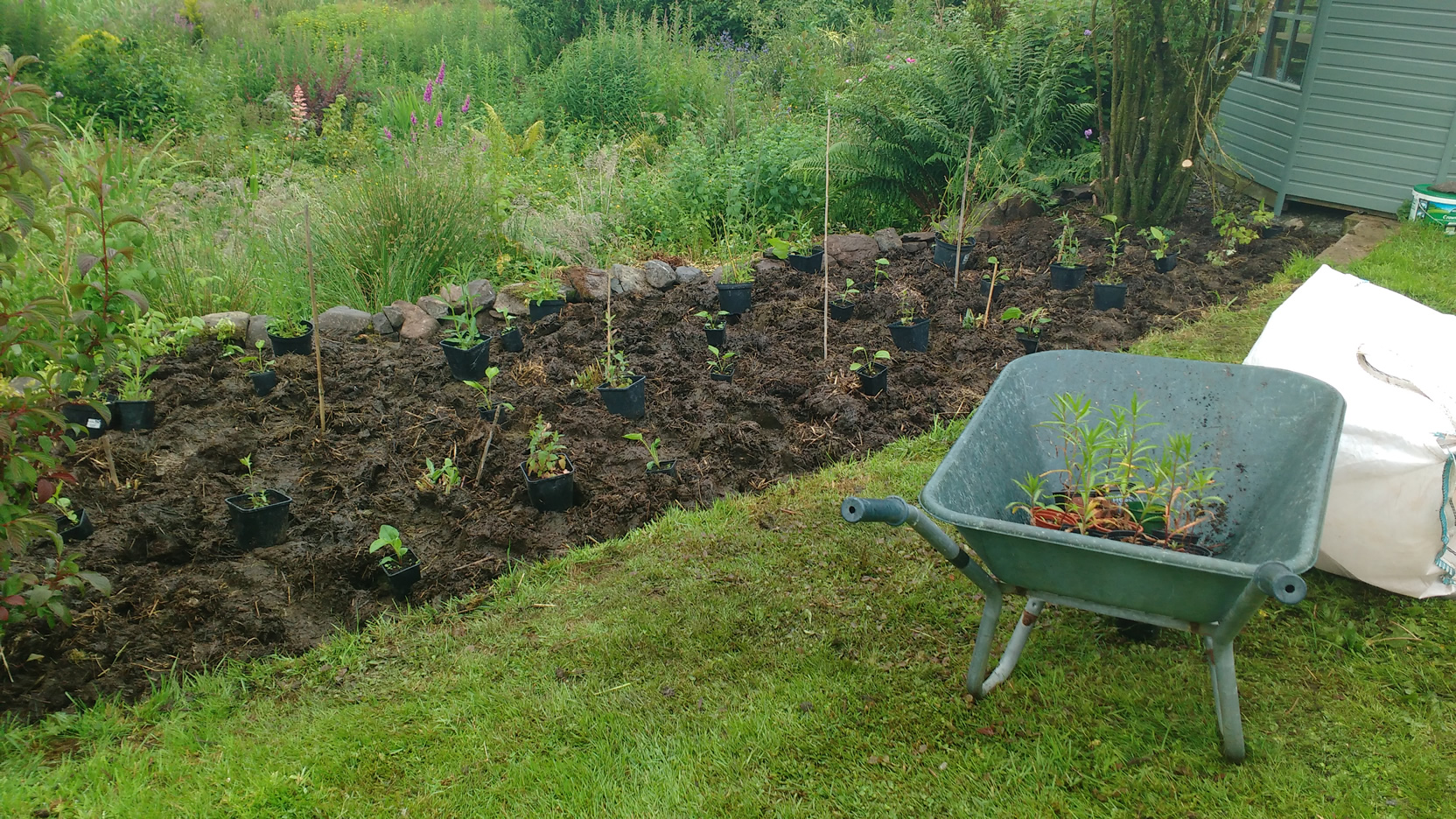
Working as a gardener and fairly busy right now, Nicole fitted this in around her work.  It was a large task and took the best part of a week to clear it.  Patiently waiting by the greenhouse were rows of carefully potted on flowers, Echinacea, Achillea and Salvias to create a wee “prairie” from the recently weeded border.  These were having to be watered daily and so would benefit hugely from finally getting into the ground.

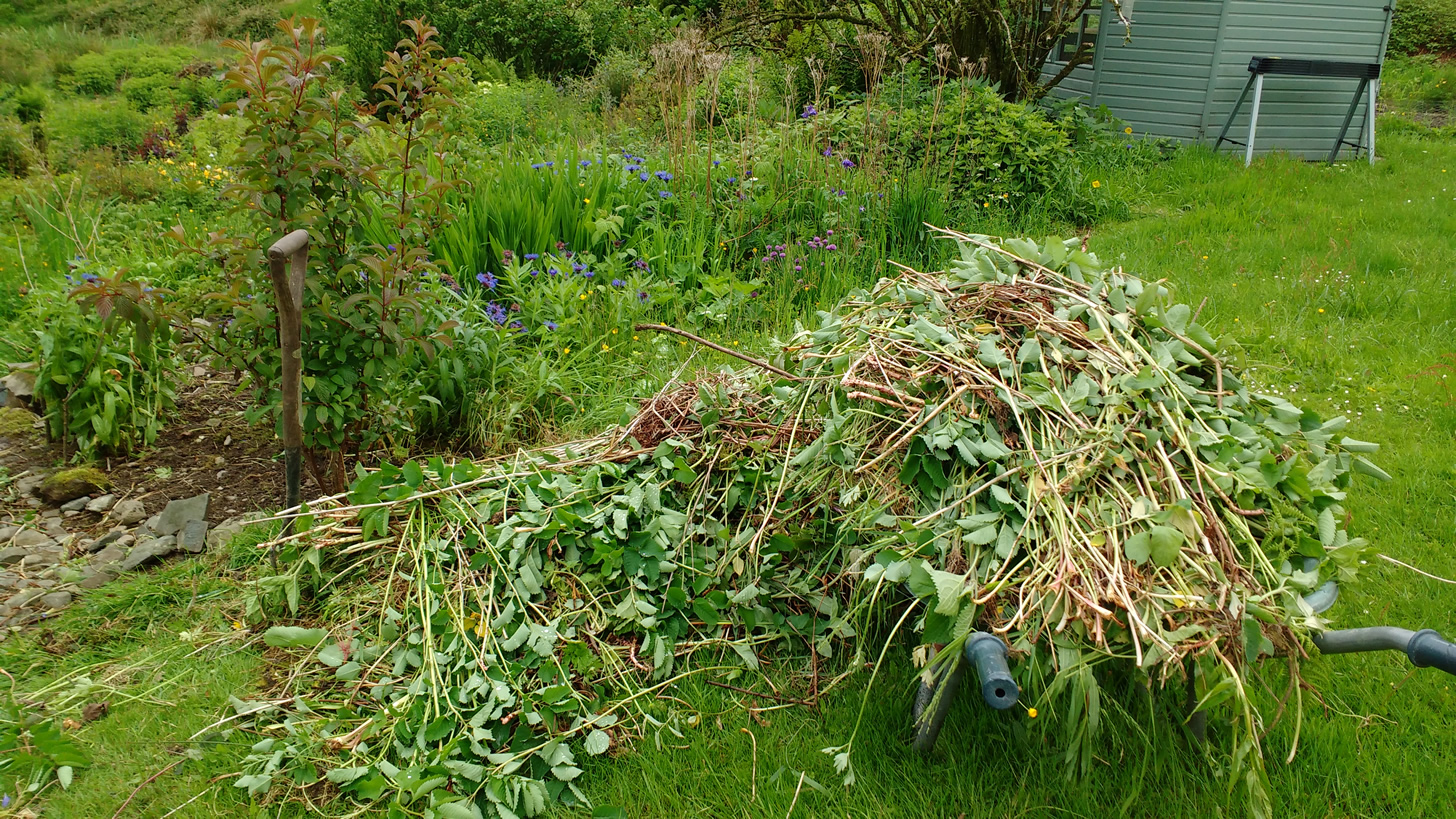
Finally, the bed was cleared and a mountain of weeds made their way to the compost bin.  Nicole was exhausted but very happy indeed.  Now for the good bit, the planting out.

flower bed cleared
flower bed cleared
pile of weeds
pile of weeds

There was no waiting or having a wee rest to recover from all the effort of clearing it.  I was on a deadline to mulch it.  Nicole headed off to work and I was straight into mulching – it took 4 trailer full’s of mulch to put a decent covering down.  Hard, but satisfying work.  There is something very attractive about a recently mulched flower bed.

flower bed woolly protection

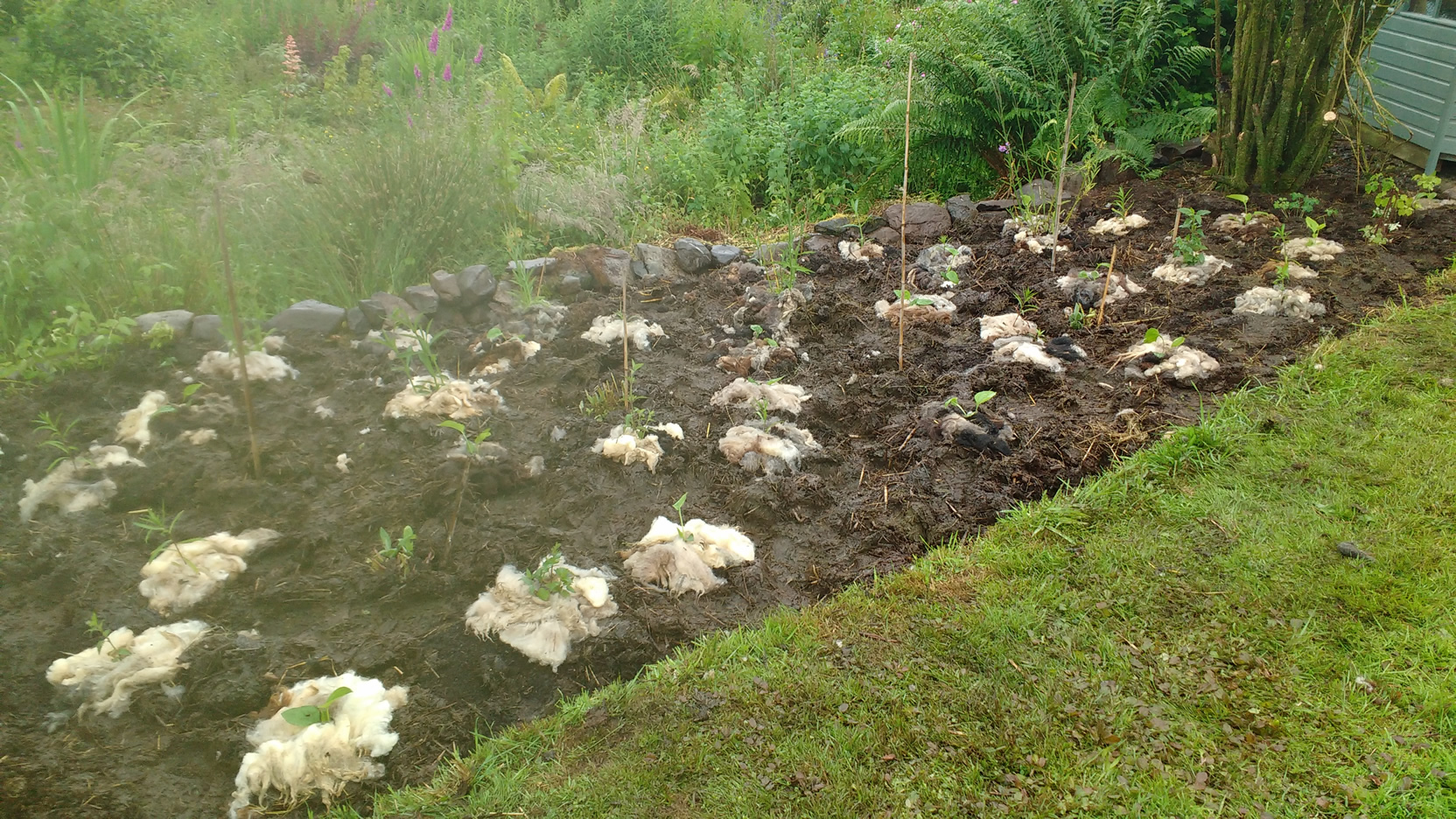
Nicole got home and after a quick cuppa, she was out planting.  Given all the problems we’ve had in the veggie patch with slugs and snails, each flower was carefully surrounded with wool.

The net result looks amazing, but will be even better once all the flowers grow and bloom.  That will most likely be next year.

Posted on Leave a comment

Cows drink us dry

As previously mentioned, we borrowed some cows from a neighbouring farm (cows return to Auchenstroan).  With them nicely settled in, I headed off to Edinburgh to meet a flamenco guitar master (for some guidance) and then a beer with friends.  All excellent.

I returned Saturday morning to a water emergency.  With the weather being warm, the cows had drained all our livestock water tanks.  Also, the burns that feed our tanks had dried up.  Nicole had taken some water over but the quad bike cannot tow that much and it’s also very slow to fill a bower from a tap.

So, it was out with the tractor, hook up the 600 litre bowser and set the pump up in the river.  We are on spring water here and during the summer filling a 600 litre bowser would empty our water tank (shared by our close neighbours).  So, it’s best to pump it up from the river.  One of my neighbours helped for which I was very grateful.  I also filled two 20 litre water carriers while I was at it.

cows queing for water
cows queuing for water

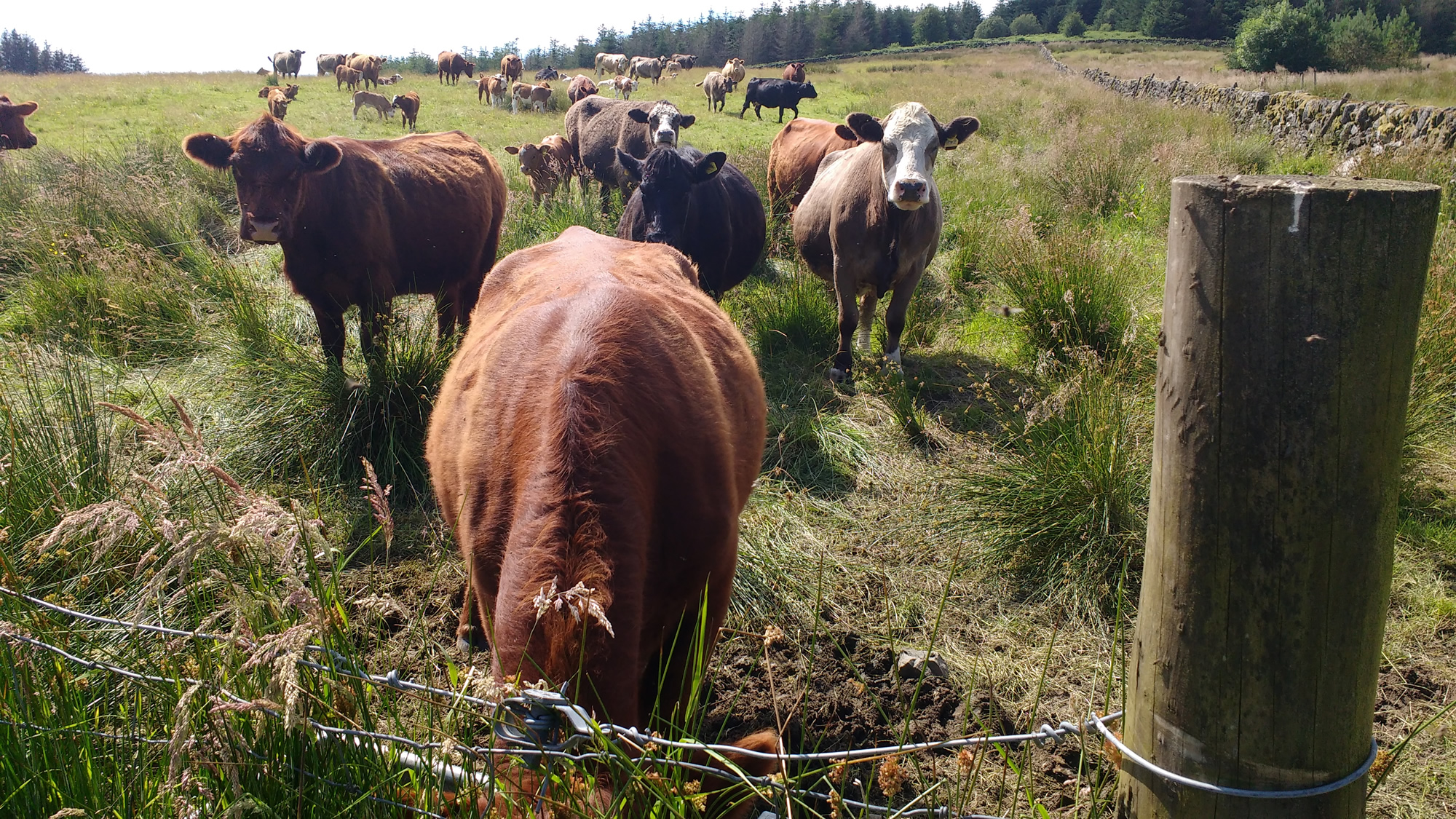
Once full, the bowser was towed to the tank and connected so the tank could be filled.  While that was happening (it takes two hours for the bowser to drain through the standard hose connector), I went to fill the trough with the 20 litre carriers.  At first, the cows were not sure what I was up to, but as I started pouring water into their trough, they formed an orderly queue headed by the brown cow pictured.

Once I had poured the two containers in, she dipped her head and drained the lot.  This could be a long day, I thought.  If you’re wondering why the troughs were not filling automatically, they were, but just not quickly enough.  The have a ballcock valve much like that found in a standard toilet.  The water flows in, but like an old tap.

Anyway, I zipped back and forth with the quad fetching water while the bowser offloaded into the tank.  On the second visit, the bull was at the front of the queue.  His head was almost as wide as the water trough.  He watched me with mildly suspicious eyes while I poured the water in.  His head was in straight after the first container, so I just poured the second one in next to his head.  He drained the lot and, sated, he wandered off.  It took about 4 trips before the queue started to thin out and 6 to get the trough back to full.  It also took three bowser fulls to fill up the tank (around 1800 litres).  Once done, I thought that was that.

No!

Sunday morning is my turn to check the animals.  I found the cows had made the executive decision to move field trampling a fence in the process.  Not much could be done, so we opened up more space for them and they seemed quite happy.  And they still had water.

Monday morning, all the water was gone, again.  They had managed to move a trough off its stand and so tilt it and drain the entire system.  I inspected all the troughs followed closely by a number of cows.  All empty.

Tractor out, pump on, refill…

Only this time, there was no water coming down.  In a mild panic I worked my way up disassembling each connection.  No water, but I could find nothing wrong with the system.

I gave up – we asked the farmer to take them back a day early as it was hot and they needed water.

Now, we have had trouble with this tank but I thought it was repaired.  In fact, the tank had appeared to be holding water again, so I had filled in the repair trench (before it collapsed).  I dug it all out again, but everything was fine.  And then the water started to flow into the troughs.  It turned out to be a small hump in the pipeline which the water level had to get above to start flowing.  Panic stations were all for nothing.  Only now, one of the connections was leaking.

Thankfully, I have a box of pipe connectors so I was able to repair it.  The pipe had shifted a bit so I had to put in a piece to lengthen the pipe so it would reach the connector properly.  By the end of the day, I had refilled the tank, repaired all the pipework and the troughs were all full again.  This time, only sheep would be drinking.

Posted on Leave a comment

Cows Return to Auchenstroan

This year, the grass has gone mad.  I have never seen it so long and lush.  To say the sheep can’t keep up would be an understatement.  In fact, of late, they have only really grazed two of the five fields they have access to.  Sheep prefer to nibble at short grass, so much of the long grass remains untouched.

cows back at auchenstroan

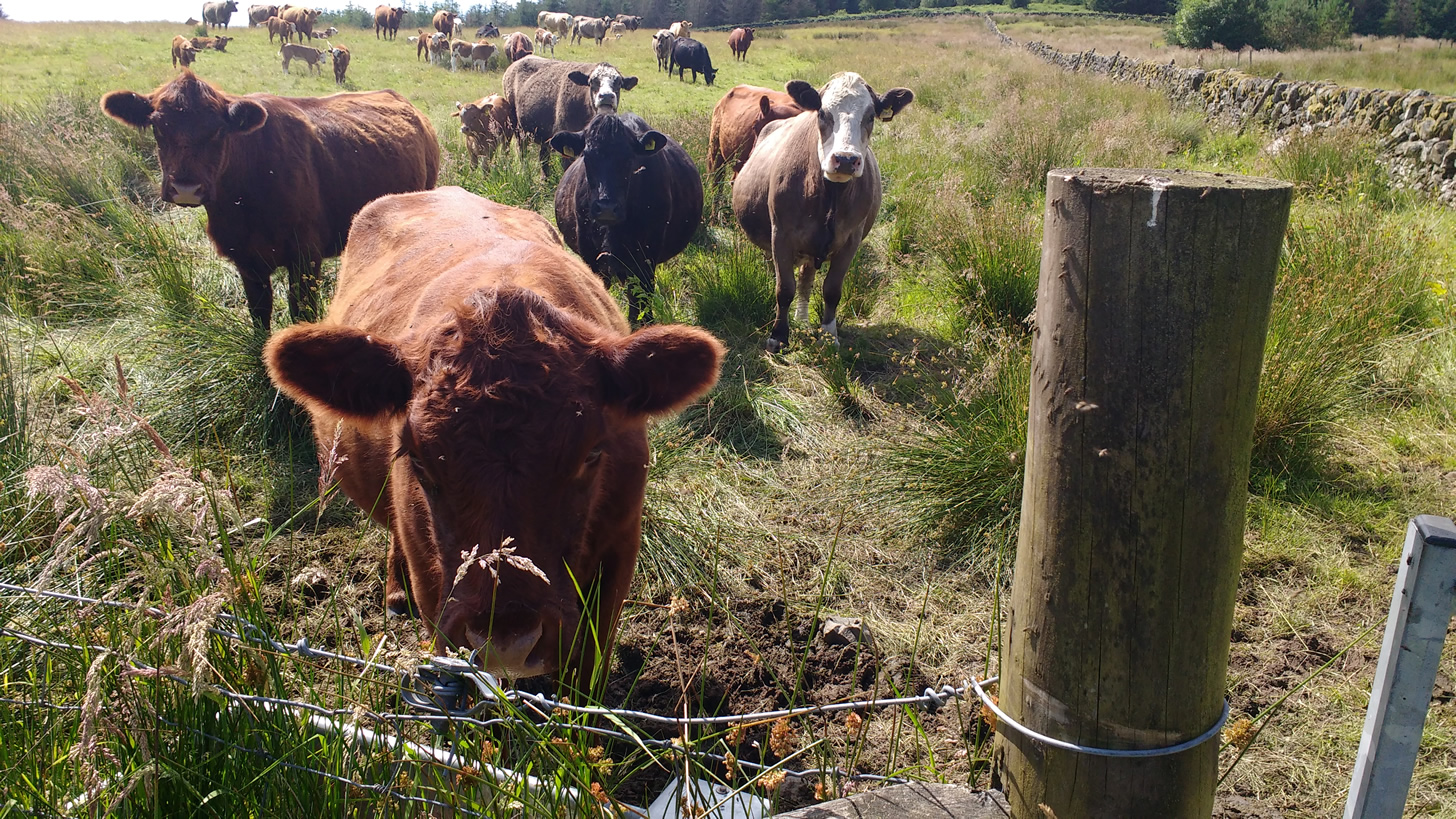
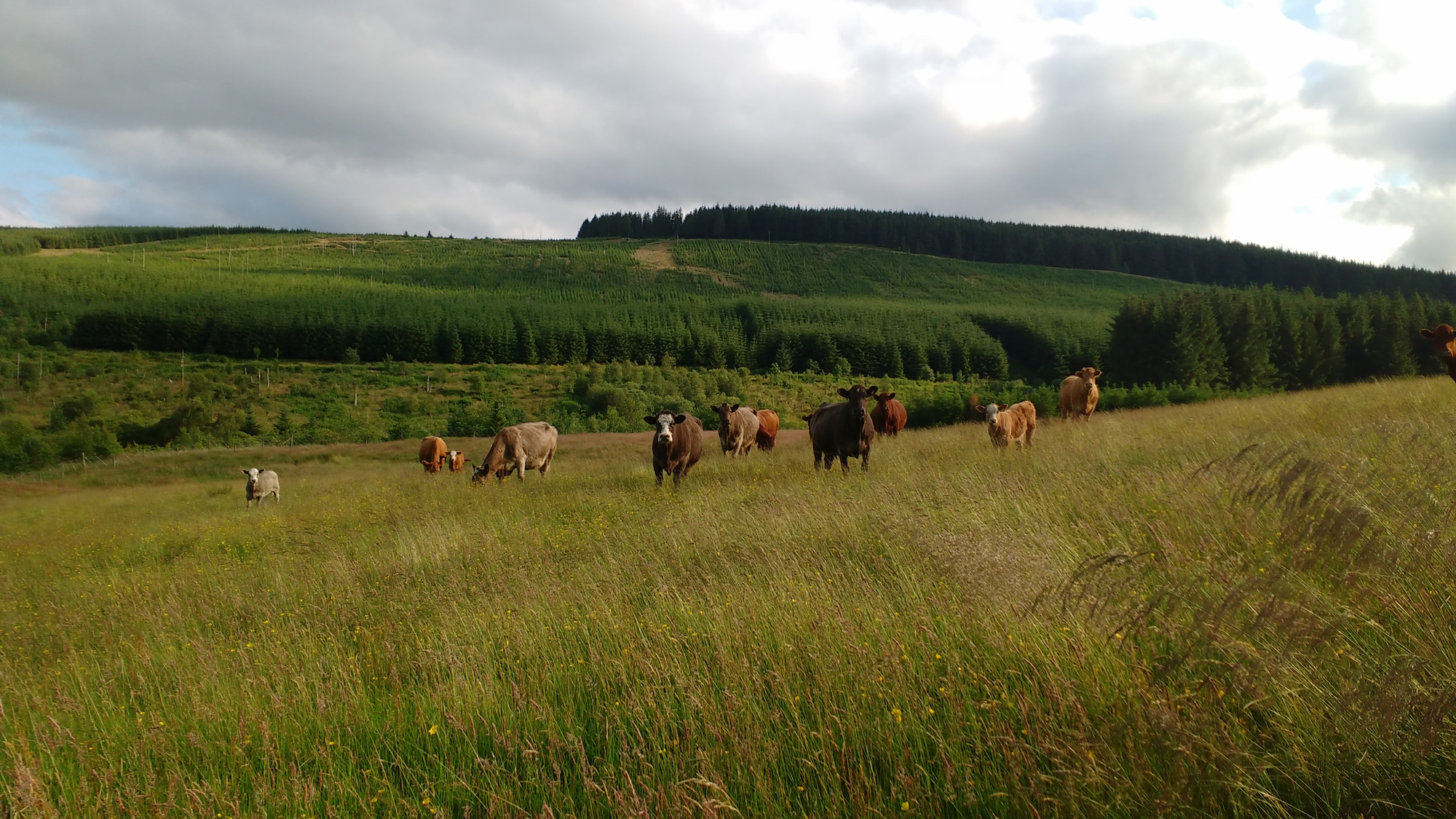
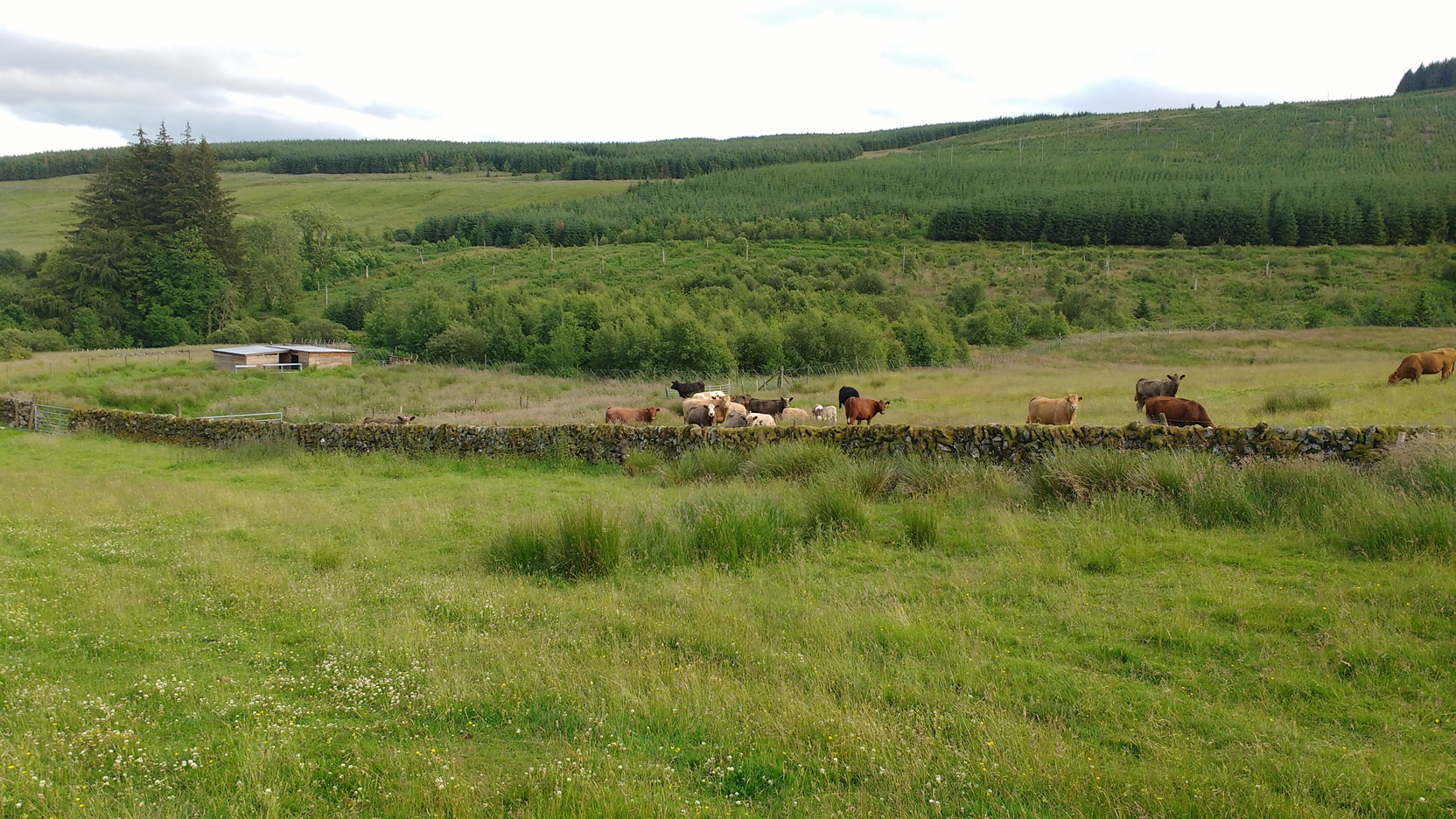
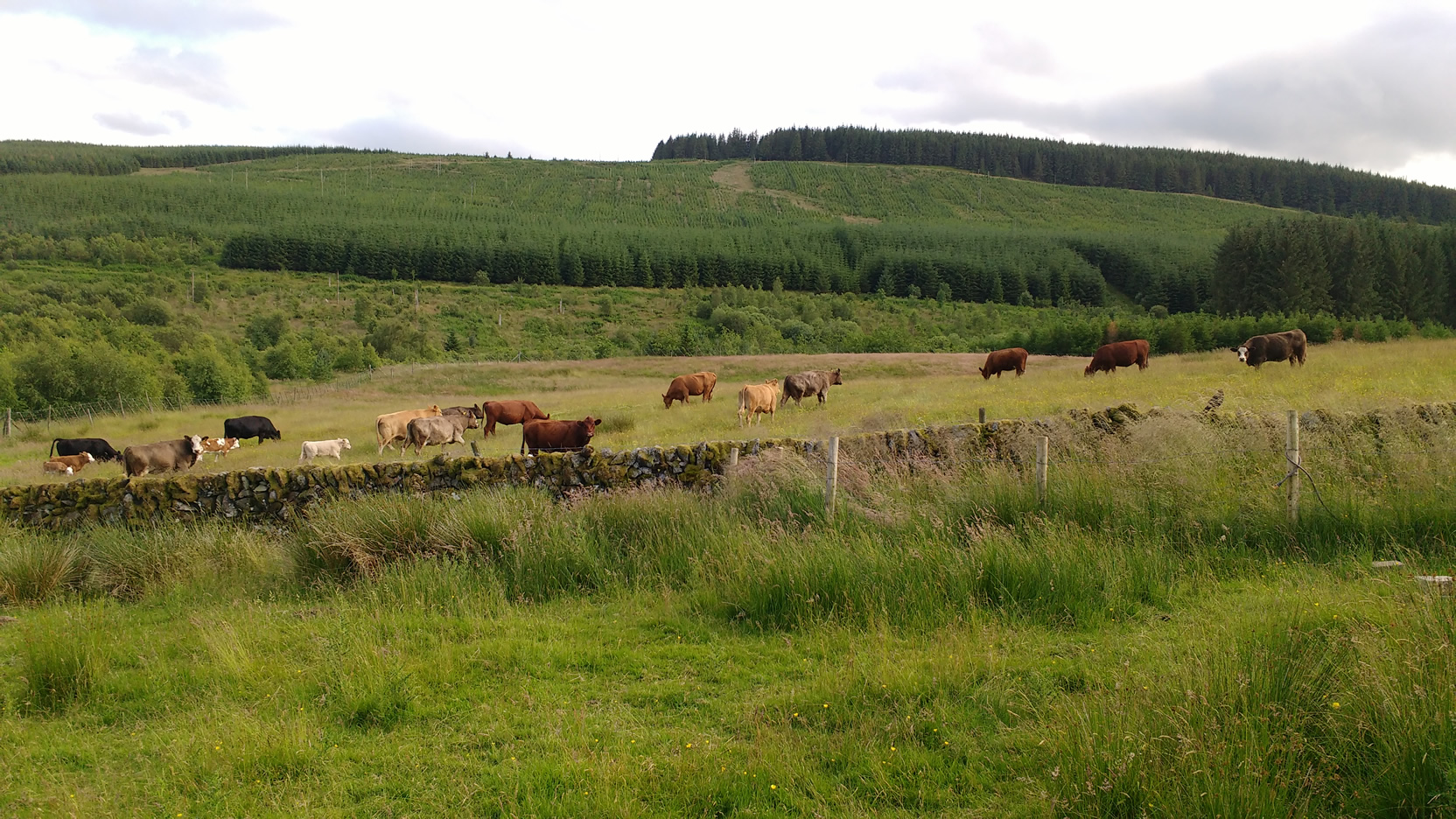
Our neighbouring farm keeps cows and a few days back, they appeared in a field next to our track (the cows that is, not the neighbours).  It was a good sized heard of around 25 with a mix of heifers, calves and a sizeable bull.  Opportunity yes, we thought to ourselves.

So, we asked our neighbouring farmer if he’d like to graze his cows in our fields for a bit.  He was delighted to do so and brought them over yesterday evening.  After an excitable period of exploring, the cows settled down and this morning, they looked really happy.  Well, it’s a big field with lots to eat, who wouldn’t be happy?

They will be with us for a few days by which time we expect they’ll have scoffed most of it.  We are really pleased because grazing cows is really good for the land too.


Posted on Leave a comment

Veggies Version 2

I wrote a few weeks back about the problems we were having getting our veggies going this year (problems with veggies).  First, the birds dug them up and then, the slugs emerged and scoffed the lot.  We ended up with around about 3 kale, 2 turnips, 4 spinach, 3 beetroots, one half-eaten broccoli and some carrots from our first planting.  All the salads have gone.  None of the direct sown seeds have emerged.  Onions aside, A bit of a disaster really.

wool protected carrots
carrots protected by wool

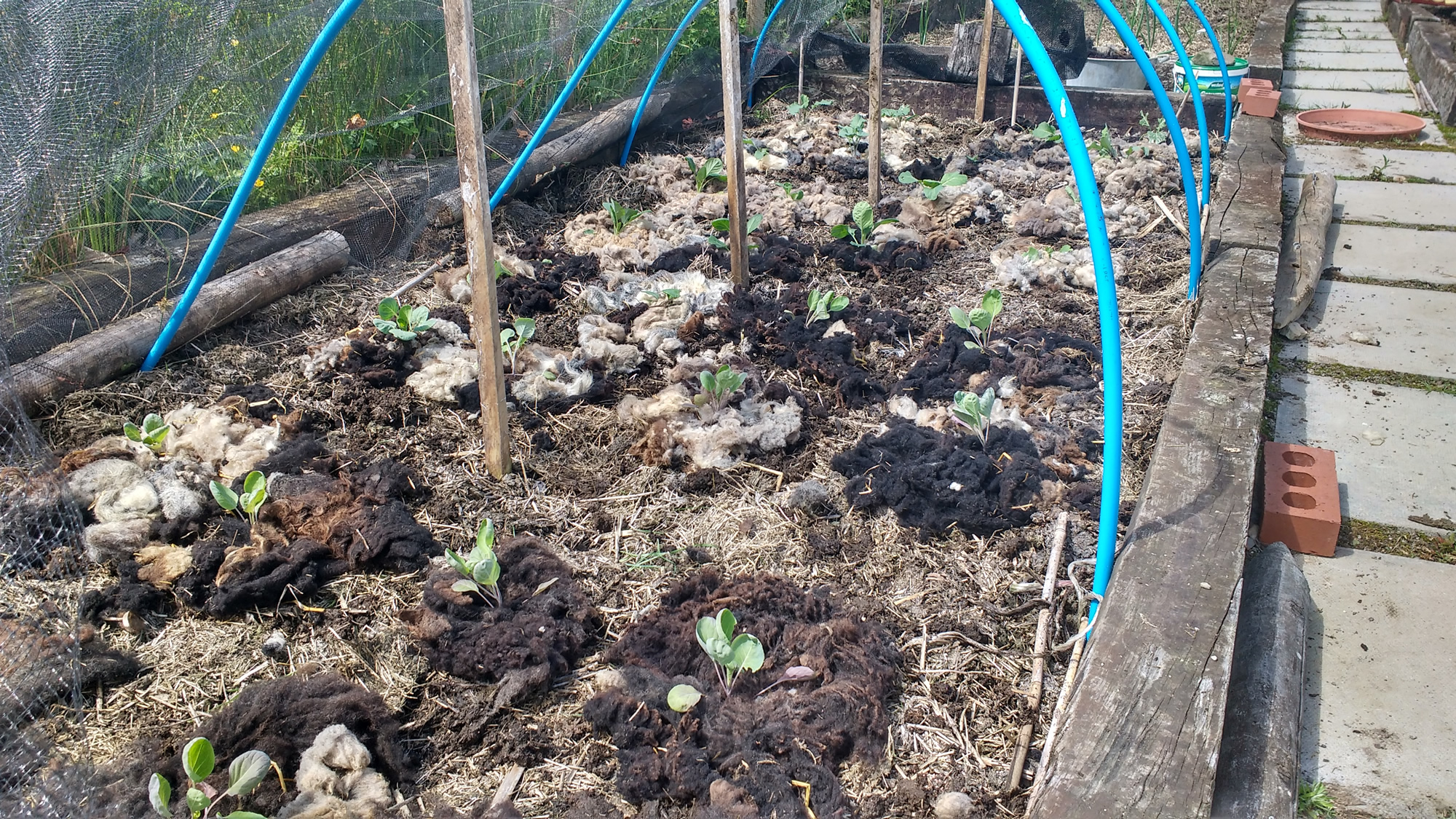
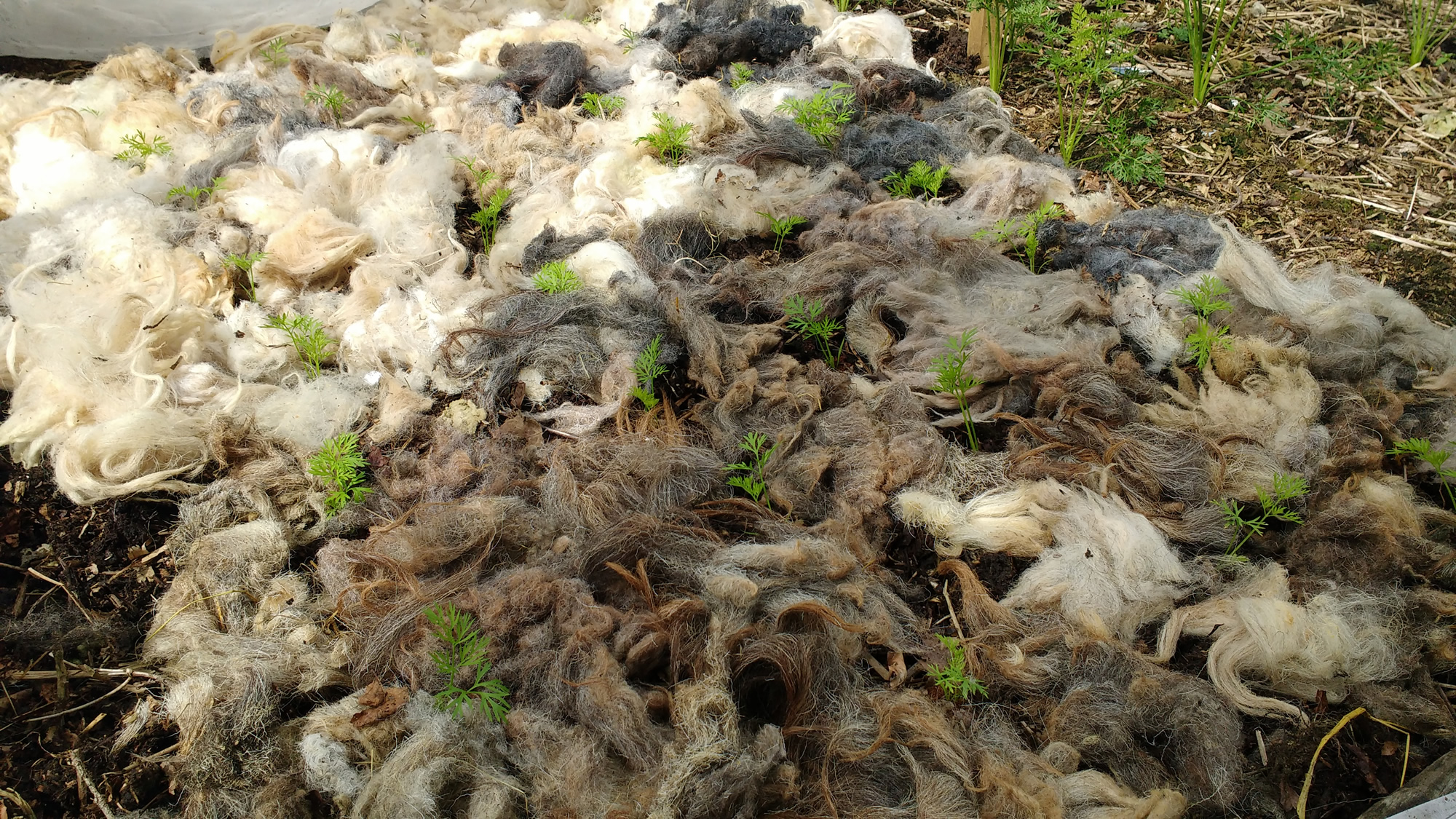
Luckily, I had kept some seedlings back and potted them up.  We also did an emergency purchase of more seeds and got them going.  The problem is, though, what to do about the slugs.  We don’t really like using slug pellets and besides, they hadn’t been much use where we had used them.  In the past, I have tried various approaches, eggshells, traps etc, but none of these were that good really.  However, Nicole read somewhere that they don’t like wool.  It’s worth a try we thought as we have plenty left over from shearing.

So, over the weekend, I have been planting out the second wave.  These are all plants that have been potted up and allowed to grow reasonably large.  This should give them a fighting chance.  Each plant has been delicately surrounded with a carpet of wool.  Rain is forecast this week, we shall soon see if that works.  Fingers crossed!

Posted on Leave a comment

Haribo Wins Top Dog Award

Haribo came to live with us a few years ago.  He came to us unwanted by his previous owner and with a list of issues over two pages long.  Most of those issues disappeared fairly quickly, but one endured.  Haribo was very scared of dogs he didn’t know and this led to a fear aggression response.  His coping strategy was to get the first attack in.

This made walking a bit of a problem, but as we were aware of this, we were able to control him.  Over time and under George’s wing (George is our Anatolian Shepherd), Haribo’s general behaviour improved, but the fear aggression stayed. In the last few months, we have noticed that Haribo just seems to have become more relaxed.  He has a very stable life here and plenty of space.  He and George are best mates and he also likes Maga, the collie who lives nearby.

Last weekend, a neighbouring cottage had visitors coming and they were bringing a dog.  A small terrier.  She’s a very relaxed dog, they told us.  Hmm, the words ‘terriers’ and ‘relaxed’ don’t often appear in the same sentence.  When I worked as a dog behaviour consultant, most of my clients were owners of small terriers.  Anyway, I said I’d manage the introductions.  On Friday afternoon, I picked up the collar and lead, but I couldn’t find Haribo anywhere.  In the end I went to the neighbour’s cottage.  Both George and Haribo really like our neighbours and Haribo often camps in their garden where it’s cool and shady.

Sure enough, there he was, fast asleep in their porch.  It turns out they had already met, Haribo and the terrier that is, and nothing had happened.  Just a small growl from the terrier, apparently (no surprises there).  We are amazed.  The first time Haribo has met a strange dog and not gone to level 10 in an instant.  He has done well.

slimline Haribo

His second achievement is that he has lost somewhere in the region of 7Kg.  Around the turn of the year, we noticed he was looking a bit porky so we cut his food a bit.  It’s our fault really, feeding him too much and not noticing the him slowly getting fatter.  Nicole discovered some lumps so we took him to the vet.  He’d already lost some weight but he was still around 7Kg overweight.  So, we cut his food a bit more.  The fatty lumps turned out to be benign and now have disappeared.  We weighed him again recently and he’s down to 28kg, much closer to his target weight of around 25kg.

He also has much more energy and is definitely enjoying his walks more.

So well done Haribo.  Given one of his previous issues was raiding bins, it’s gratifying that even with his diet, this never happens.  In fact, we can leave the animal room open (where we store animal feed including dog biscuits) and they never help themselves.

Pack leadership really works wonders for dogs.

Posted on Leave a comment

Summer Shelter Gets Our Approval

Hi, I’m Selene.  I’m the leader of this little flock of sheep.  I know Peaches might have something to say about that, and maybe Ursi too come to think of it, but I see myself as leader.  Where I go, the rest follow, most of the time.  Anyway, it doesn’t really matter too much, we sheep are very good at resolving any differences we might have.  We just put our heads together and come up with a solution.  Easy peasy!

Anyway, I heard a rumour that we sheep had been shown into a new shelter for the summer and then forgotten about it straight away.  Not true.  What is true that we were a bit flummoxed when our regular shelter was closed off to us.  We like it there.  We can get to any of our fields directly.  Now, if we want to get to the big field and we’re in the lower hay field, we have to go all the way round.

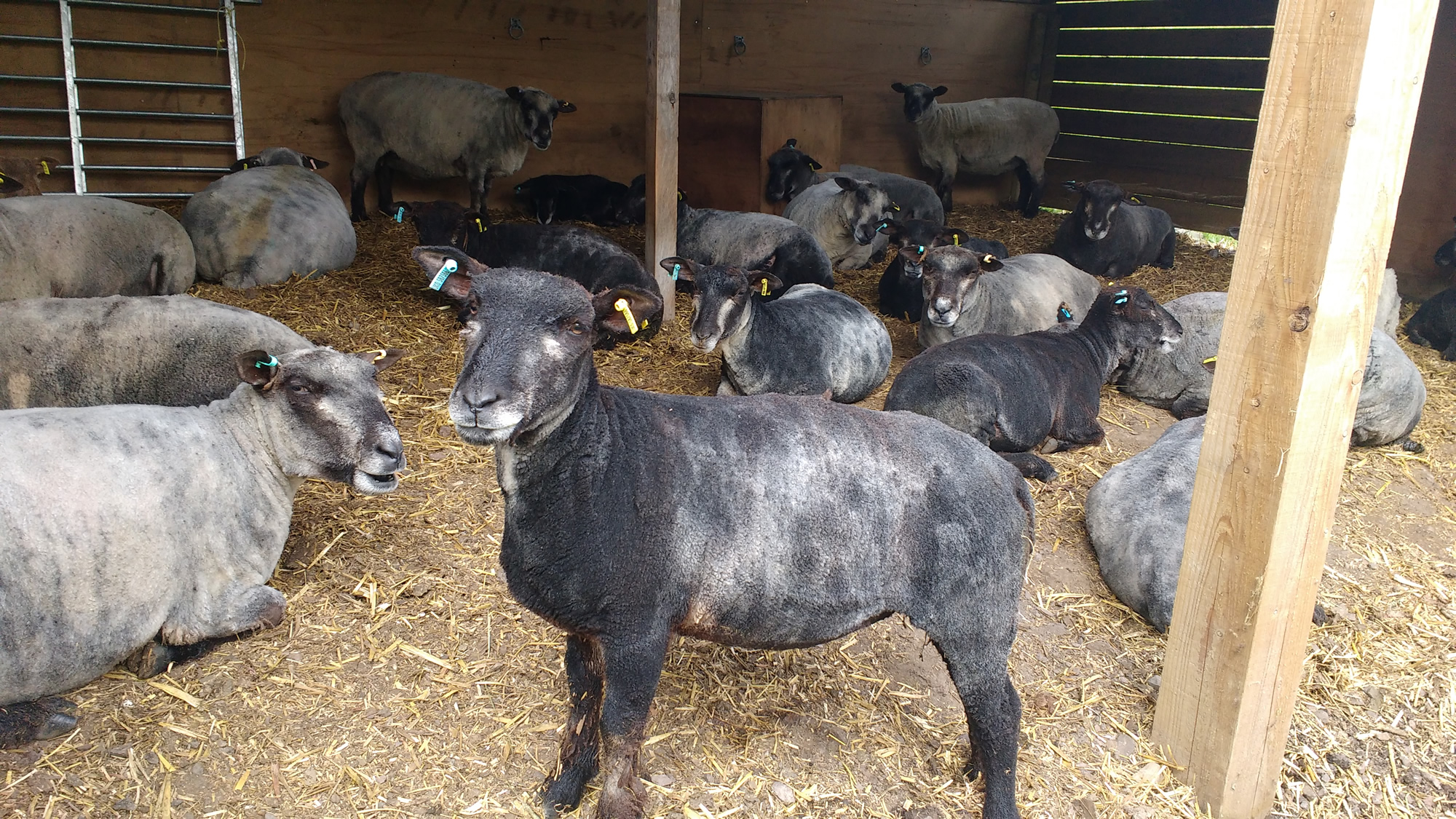
Us resting in our summer shelter

Anyway, I digress.  Our normal shelter was a bit muddy and some early summer rain hadn’t helped.  The humans had put in a connection to what they call the lambing paddock.  There’s a great shelter there – I was one of those fortunate enough to use it during lambing last year.  It was great because I wasn’t even pregnant but I still got sheep nuts, yum.

Where was I? Oh yes, we’d been shown a new path.  Well, it was very nice with lots of fresh grass, but I did remember that last time we were there, we had our coats shorn off.  While, at the end of the day, we are pretty pleased about that, it was a bit stressful at the time.  So, when we found we could go back to our normal fields, I thought it maybe best to avoid the new shed for a bit, just in case.

The only thing was, I hadn’t checked the weather forecast.  Luckily for us, the humans had, and they brought us back into the shed just before the heavens opened.  It was great listening to all that rain falling yet staying completely dry.  Especially as none of us had a coat.

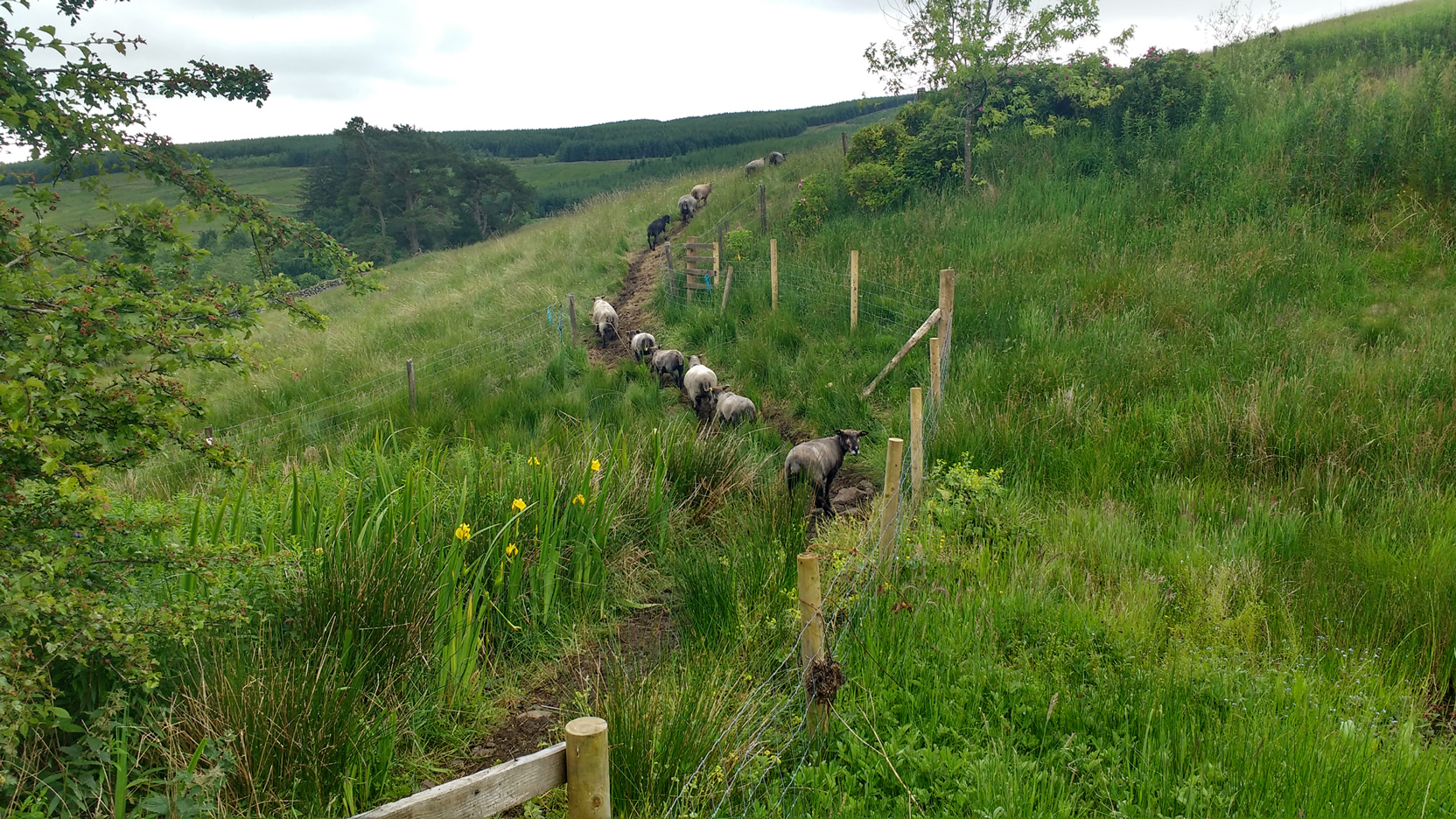
testing the new path

Anyway, after that, we tested the new path a few times, but there was no sighting of the shearer.  A few rather nonplussed hens, yes, but they soon got used to us.  Turns out they’d had the shed to themselves for a while and were used to kind of mooching about in it undisturbed.  On the plus side, I pointed out to them, they also had access to our sheep path and could free range as far and wide as they liked.  And, indeed, it wasn’t long before they were off exploring.

So, on the whole, we like the new shelter.  I wonder if we’ll get to use it in the winter too.  I hope so.

Posted on Leave a comment

Wool Glorious Wool

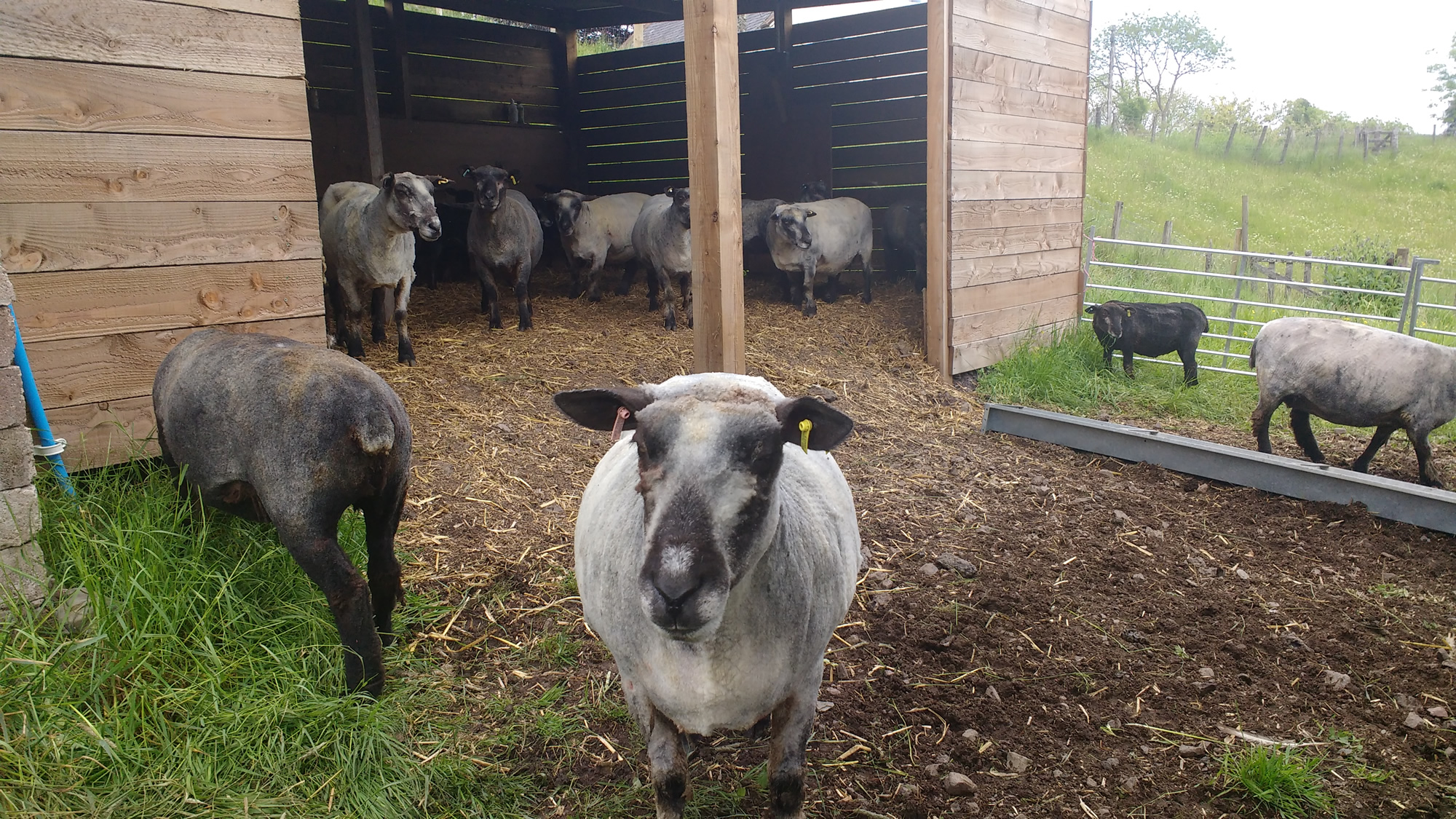
It’s shearing season here and sheep all over are having their wool sheared.  Given that it’s been quite hot for a couple of days, our sheep are quite happy not to be sporting their woolly coats right now.  Shearing is also important for health, hot weather means more flies and blowflies, in particular, can be quite a threat to sheep.

fleeces dried and bagged up
Coloured Ryeland fleeces dried and bagged up

One of the sad facts is that, these days, wool is almost worthless.  Most is bought by British Wool for less than a pound a fleece.  That’s pretty much what it costs to shear a commercial sheep.  For small flock owners like us, the cost is higher.

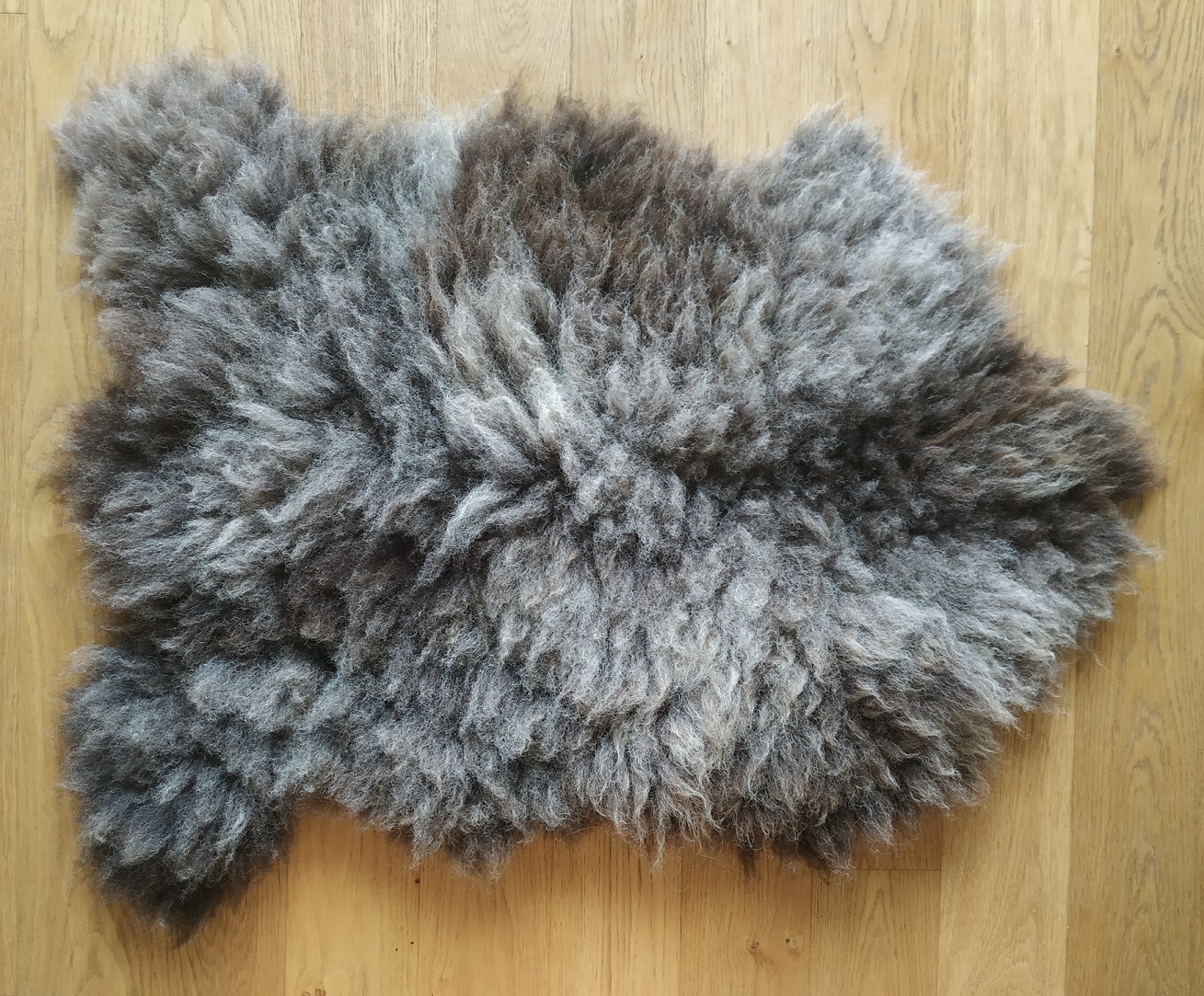
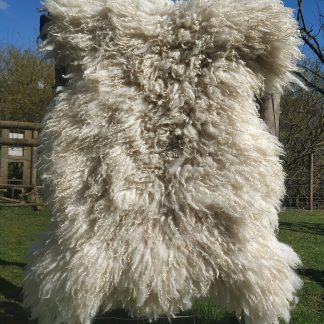
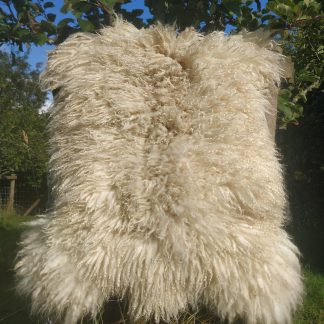
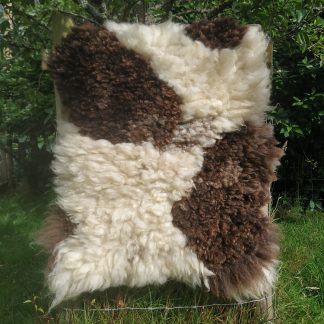
Nicole recently started making felted rugs (felted fleece rugs at Auchenstroan).  These are starting to prove popular and so Nicole is planning to ramp up production a bit.  This mainly involves drafting me in to help.

shetland fleeces drying in sun
Shetland fleeces drying in the sun

We have a few fleeces left over from last year and 27 of our own Coloured Ryeland fleeces from this year.  However, we thought it might be good to see what kind of rugs could be produced by other breeds.  So, we have got a few fleeces from our Farm-sitter’s farm (pictured at the top) and also some Shetland fleeces from a smallholding further up the road from us.

It will be good to see how the rugs turn out. They will appear in our shop as they are finished.