Posted on Leave a comment

Dry Stane Dyke Rebuilt

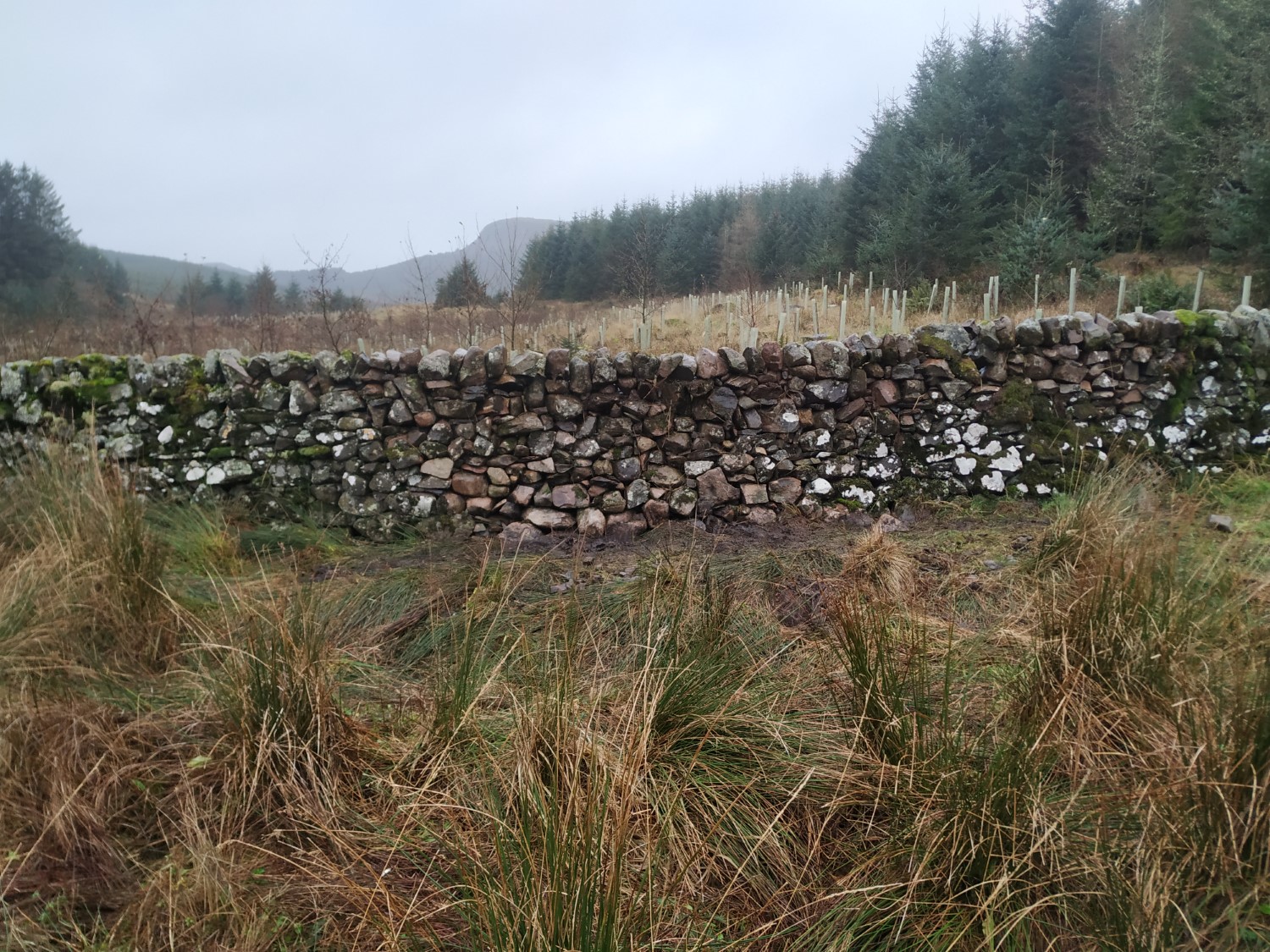
dry stone dyke repairs

One of the common themes of this blog is the repair of dry stane dykes (dry stone walls). Most of these repairs are carried out in order to keep the sheep in, but some are just because we like these walls and want them to look good.

dry stane dyke falling down

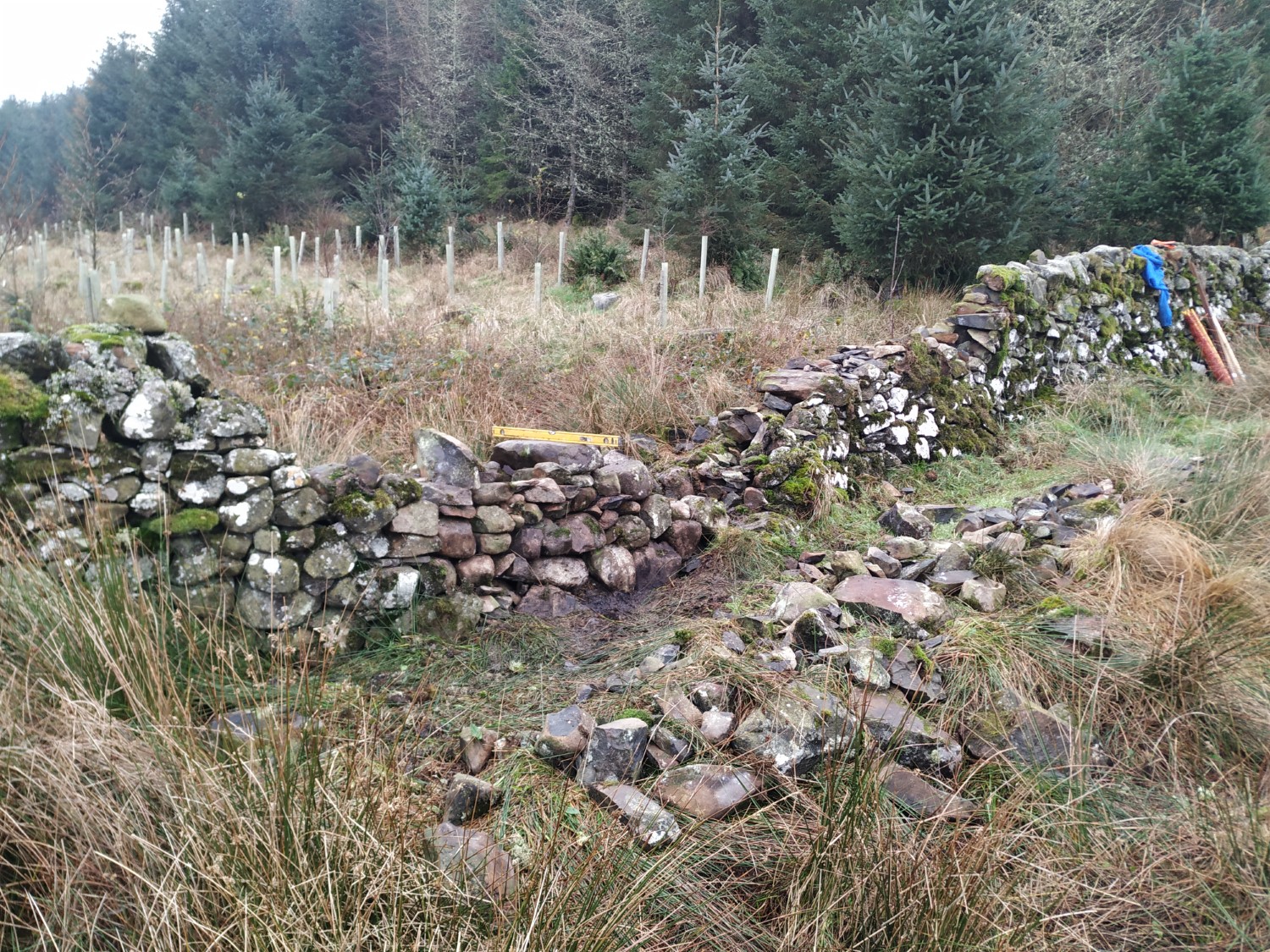
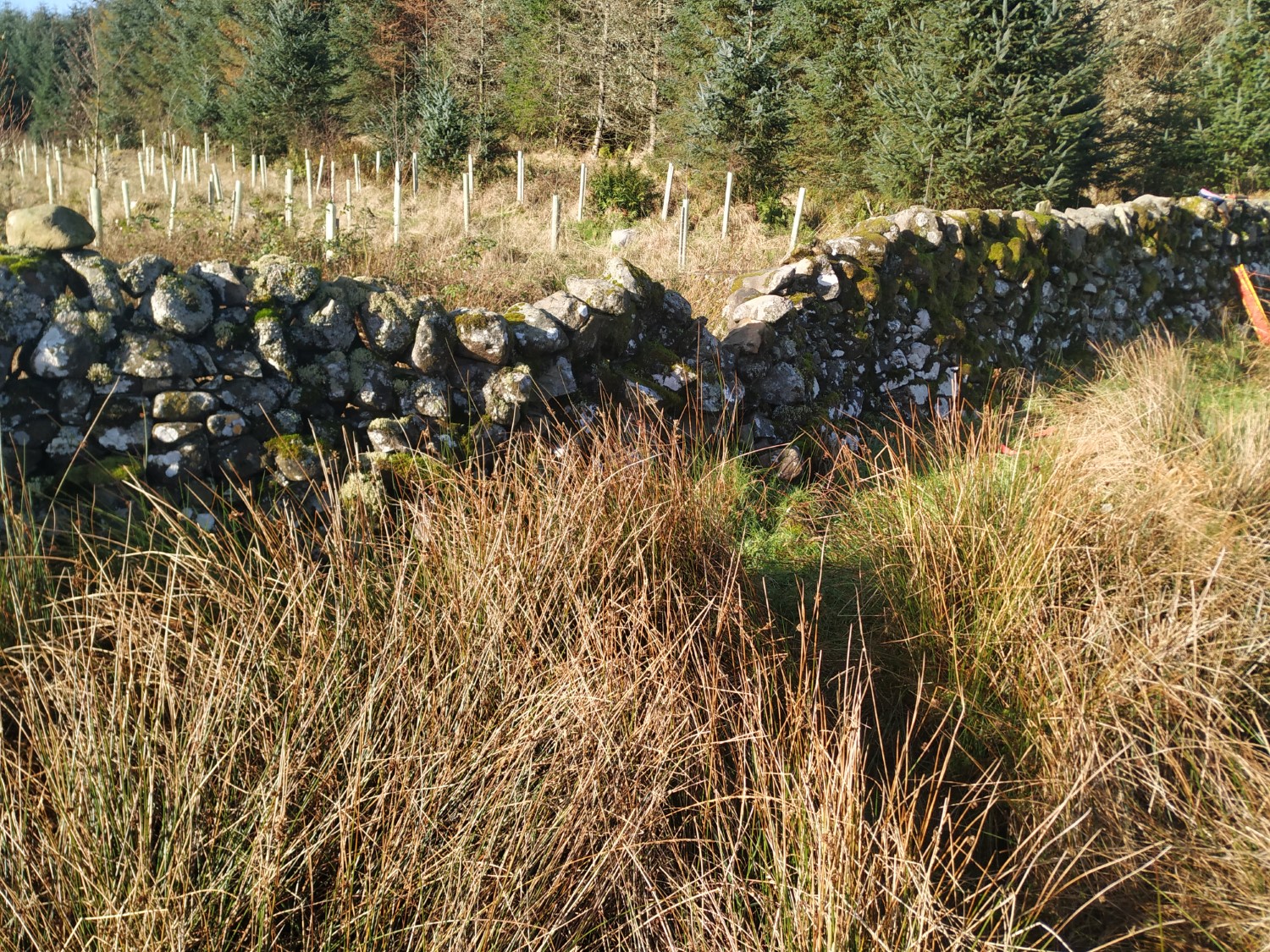
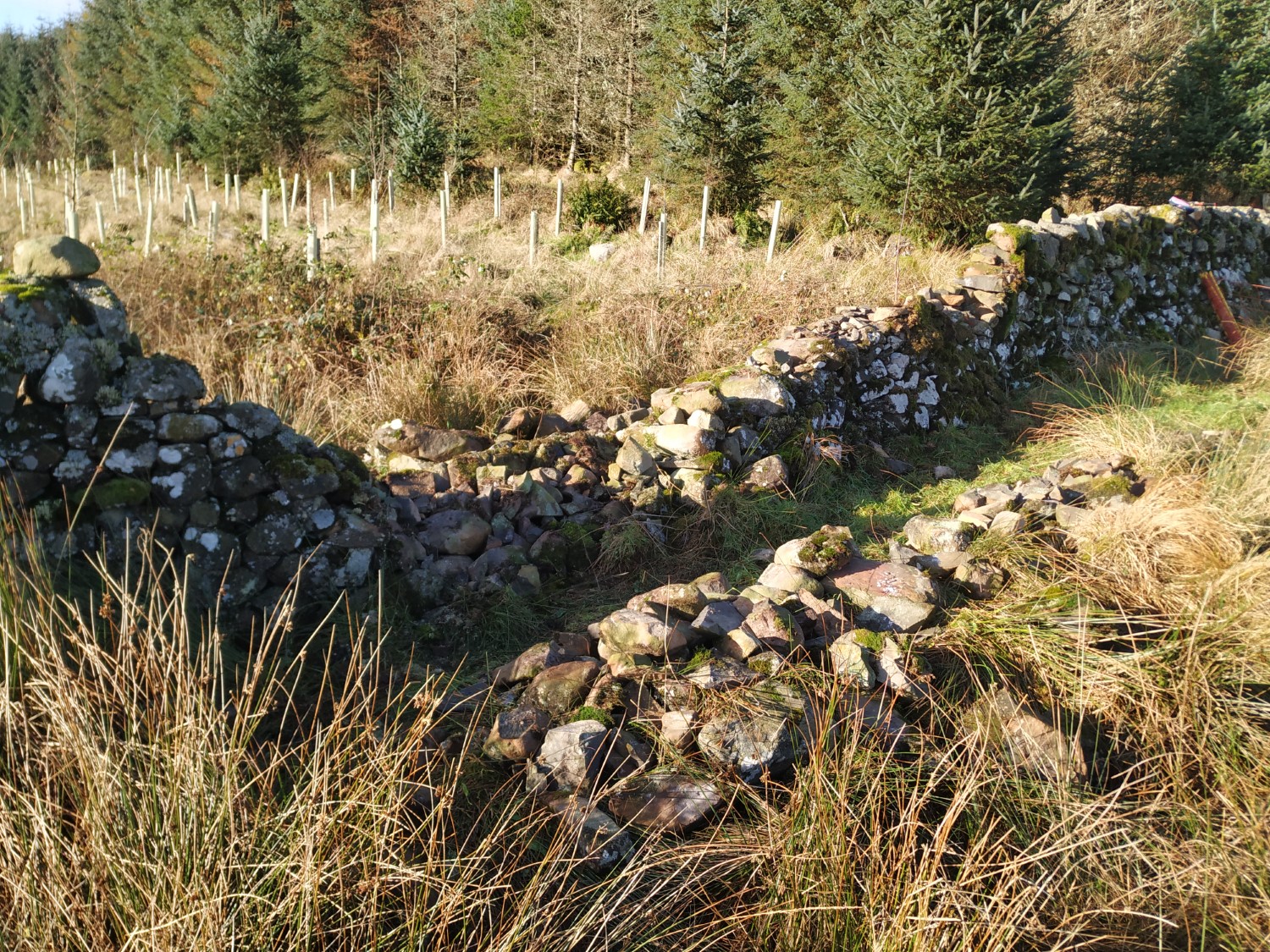
The latest section needing repair was at the far corner of one of the fields. As ever, a small section had crumbled but repairs extended quite far in both directions. In fact, this wall is very old and there has been a lot of subsidence, so much of it is teetering on the brink of collapse. Finding an upright section either side of the crumbling part was something of a challenge.

dry stone dyke - section to be repaired
dry stone dyke – section to be repaired

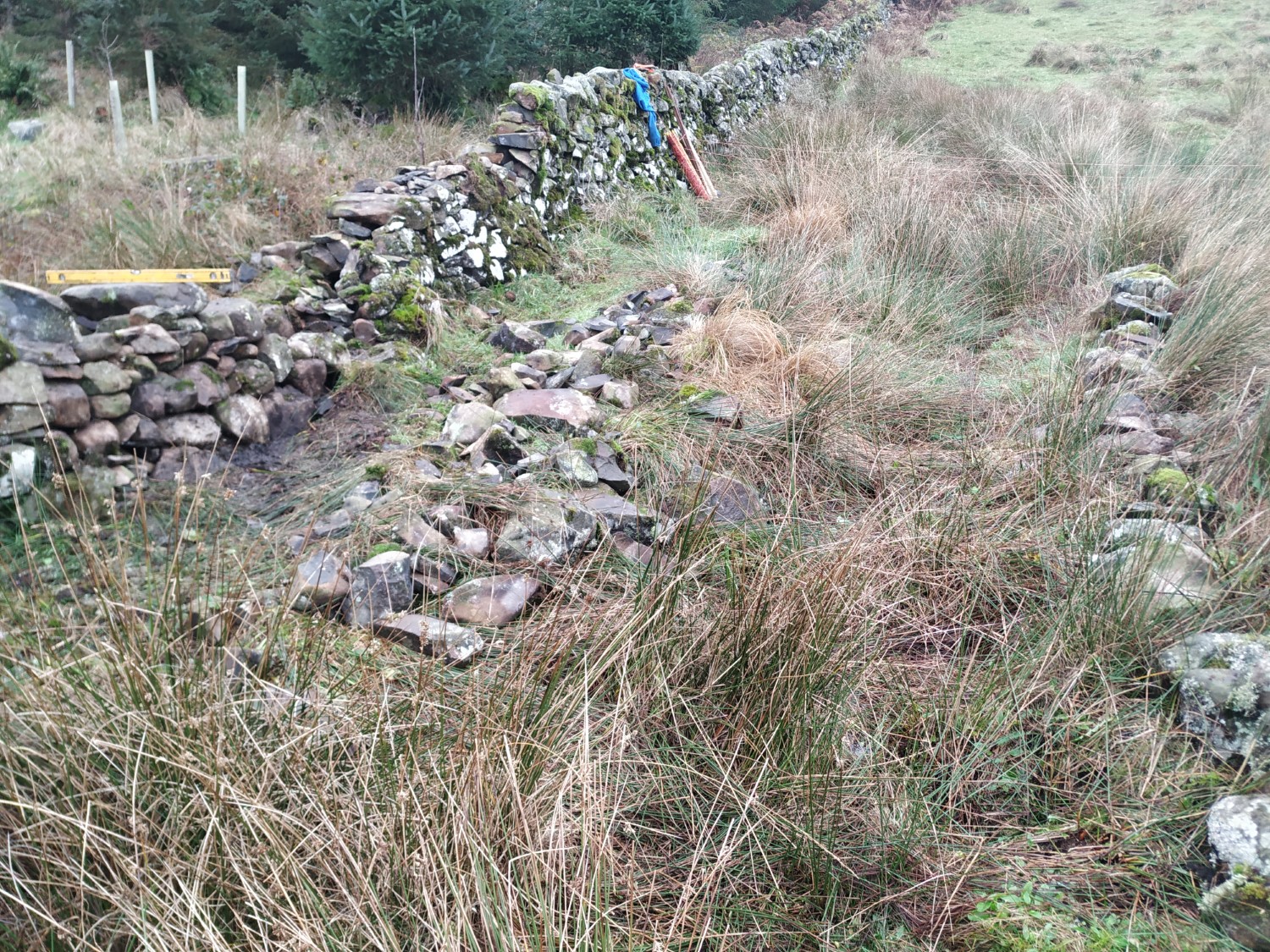
In the end, I had to take down around 6.5 metres. Being a boundary wall, it was 1.5 metres tall (5 feet), so that meant moving a lot of stone. A rough calculation showed it to be about 5,000Kg (5 tons). On top of that, it was built in the Galloway style which means big stones near the top. I made sure to keep my feet well clear as those stones were taken down.

As ever, the demolition phase was not too hard, the most strenuous part being carrying the the top stones a few metres to one side. I always keep them in a line so I know I’ll have enough nice stones to finish the top of the wall when I get there. In this case, a drainage ditch forced me to carry them a little further than usual.

dry stone dyke stones layout

The big beasties I lined up close to the wall (on the far side, so not visible in the pictures). The rest I piled up nearby ready so they would be close at hand.

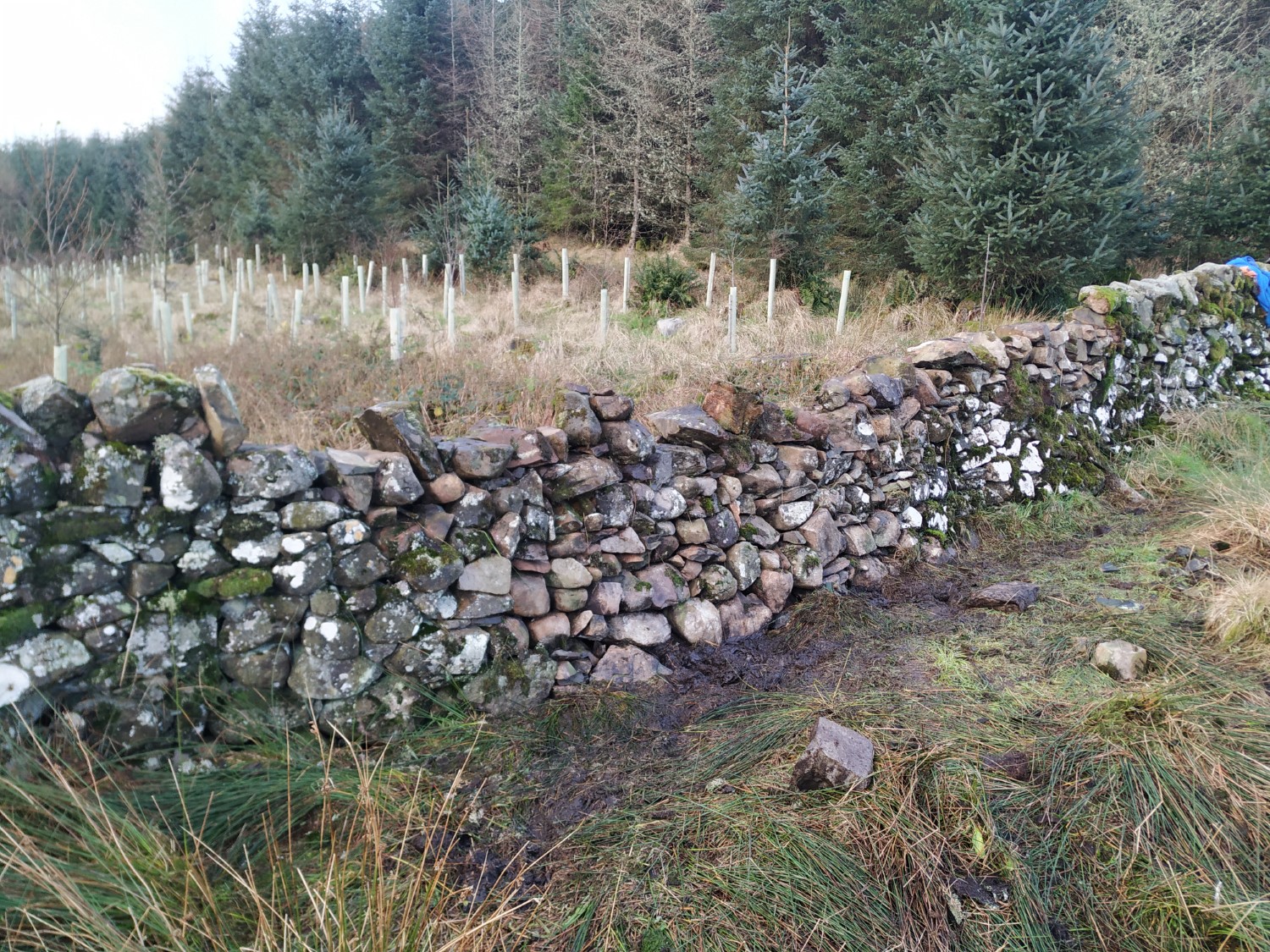
Over a few days in various weather conditions (from sunny to windy rain), I built the layers up. The ground was very soft and soon turned to mud. I found myself sinking from time to time as I attempted to lift larger stones onto the wall.

dry stone dyke - big stones on top
dry stone dyke – big stones on top

The big stones that went onto the top section I did in one session. I just picked them up and manoeuvred them into place, one at a time, hoping they would fit together nicely. It seems to have worked. Only one or two gave me grief, doing their best to slide off and land on my feet. They were the biggest two and needed some clever lifting to get them up there given the wall was around a metre high at that point.
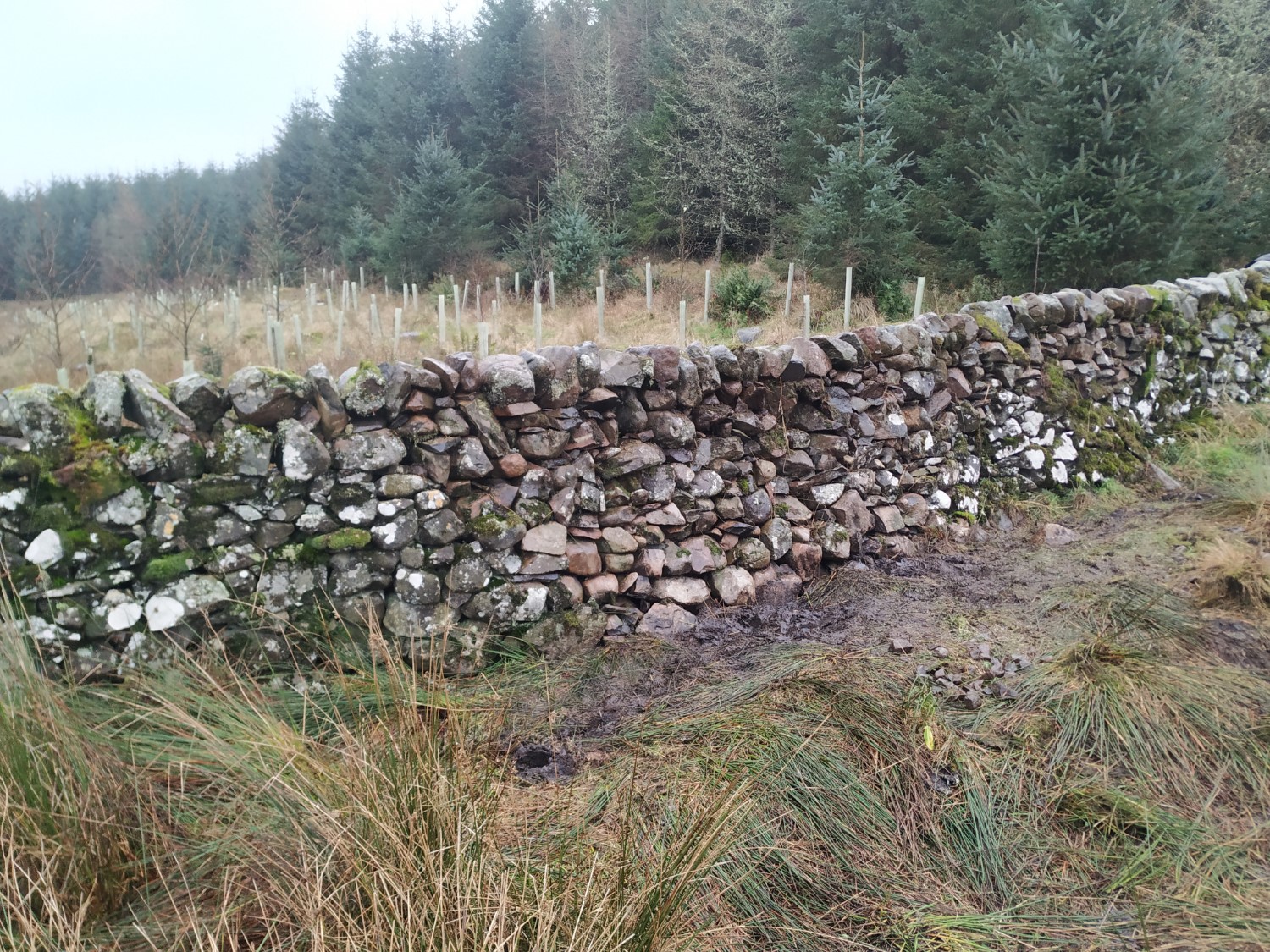
dry stone dyke - repaired
dry stone dyke – repaired

For the final section, I brought in some additional stones, just in case. A huge pile seems to evaporate when fitted neatly together. It was good forward thinking as I ended up using them all.

Despite the weather morphing from bright sunshine to blustery rain and the impatient whining of Elliot, who found the whole process a bit of a bore, I persevered and got it finished. It is always tricky to get the top stones aligned neatly, but ultimately very satisfying.

Usually, I sit down and admire my work a while when I finish, but inclement weather and impatient dogs persuaded me to head back the moment the last stone was in place. I shall have to make do with the photos on this one.

dry stone dyke repaired - front view
dry stone dyke repaired – front view
Posted on Leave a comment

Bottoms, hooves and face trims

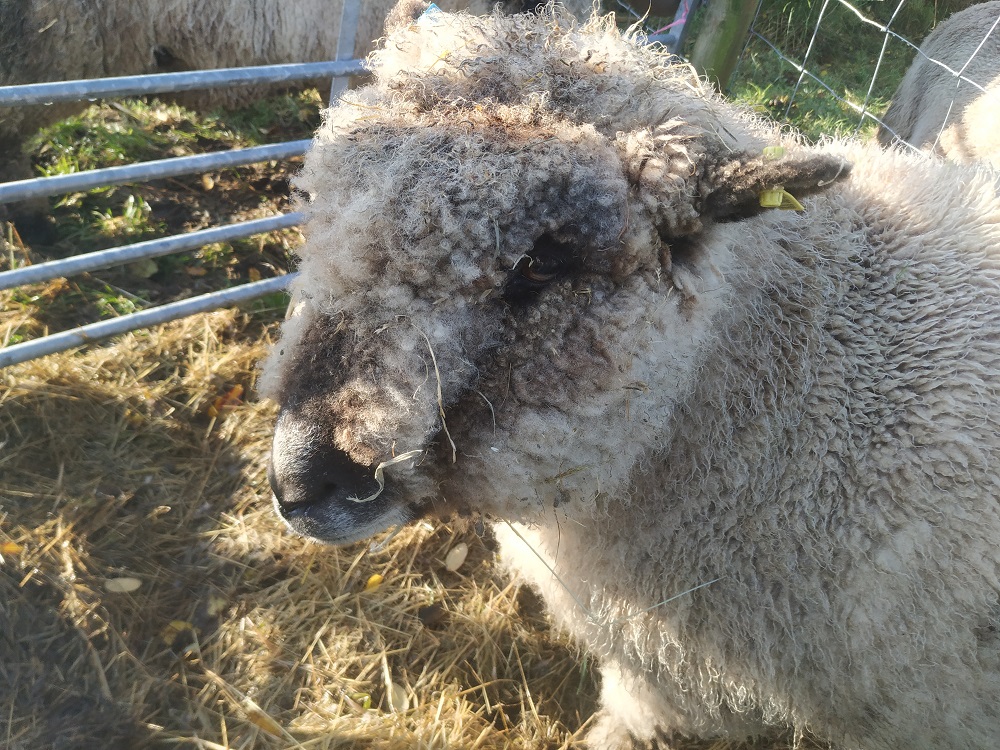
In the sheep world, Ryelands are often referred to as “teddy bear sheep”.  The reason for this, as you might have guessed, is their striking resemblance to roly poly teddy bears.  Most sheep have wool only on their backs, with their faces, tummies and legs remaining almost bare.  The Ryeland however has wool all over and can cause shearers to go a little pale.  It can be tricky to shear those woolly faces, tummies and legs and it takes longer too.

Yaar “before”

One of our jobs in making sure our Ryelands are happy and healthy is to keep their bottoms and faces trimmed.  During the summer months it’s especially important to keep their bottoms neat because woolly bottoms attract flies and flies are bad news for sheep, especially the blow flow.  We don’t use chemicals on our little lot so we take special care to keep their rear ends spick and span at all times.

We also keep their faces trimmed.  If we don’t trim around their eyes, they can become ‘wool blind’ (where the wool grows around their eyes preventing them from seeing).  Being ‘wool blind’ makes sheep unhappy as they like to be able to see what’s happening around them in order to feel safe.  Sheep have surprisingly good vision, they can see all around them, almost 360 degrees.  If they have wool growing around their eyes they can get nervous and twitchy because they lose the ability to check for predators which is an important part of being a sheep.

Yaar “after”

It’s a lot of work trimming all those faces and bottoms, (and not to mention hooves), so we rotate through the flock each week and work on three or four at a time.  Yesterday it was Yaar, Seline, Scarlett and Vera’s turn for hair cuts.

Adrian and I have got a little hair salon set up in the orchard, we put together some hurdles and bring the sheep in one at a time.  They seem to quite enjoy it and we have no trouble bringing them in.  It’s a good opportunity for us to catch up with the flock and spend quality time with our teddies.


Posted on Leave a comment

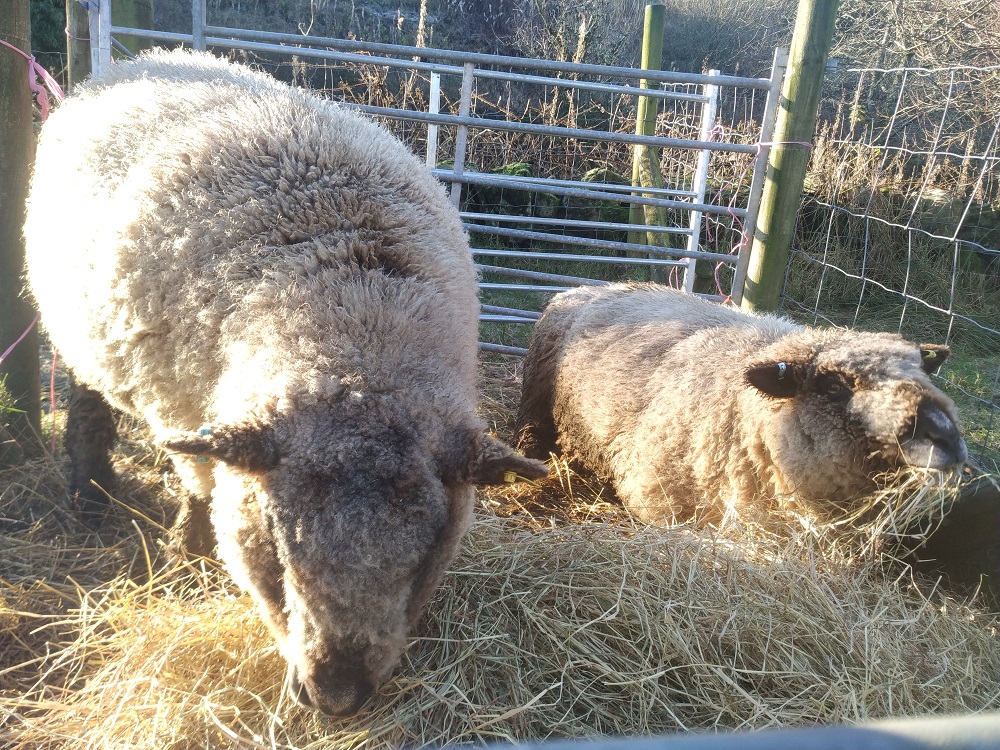
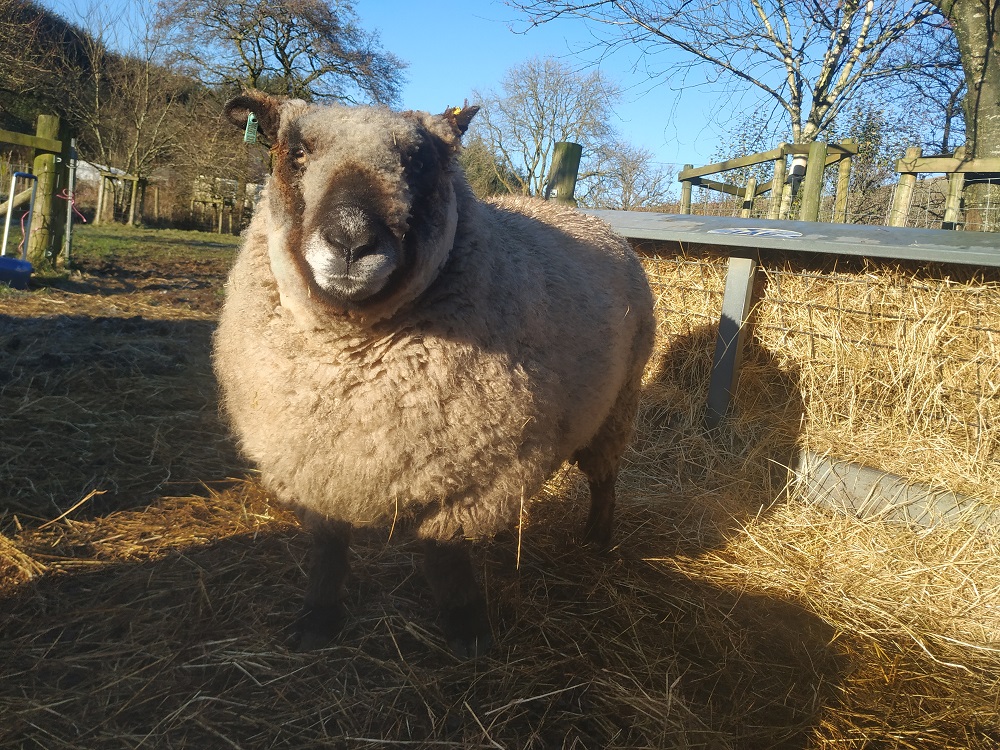
The hay ceremony begins again

to eat grass or not to eat grass, that is the question

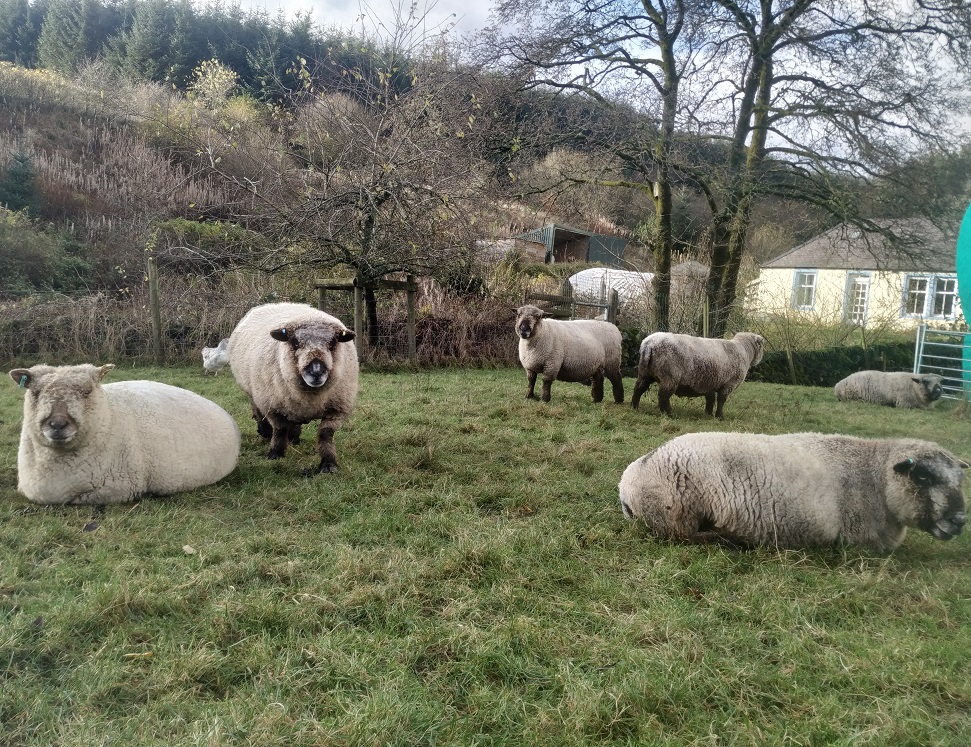
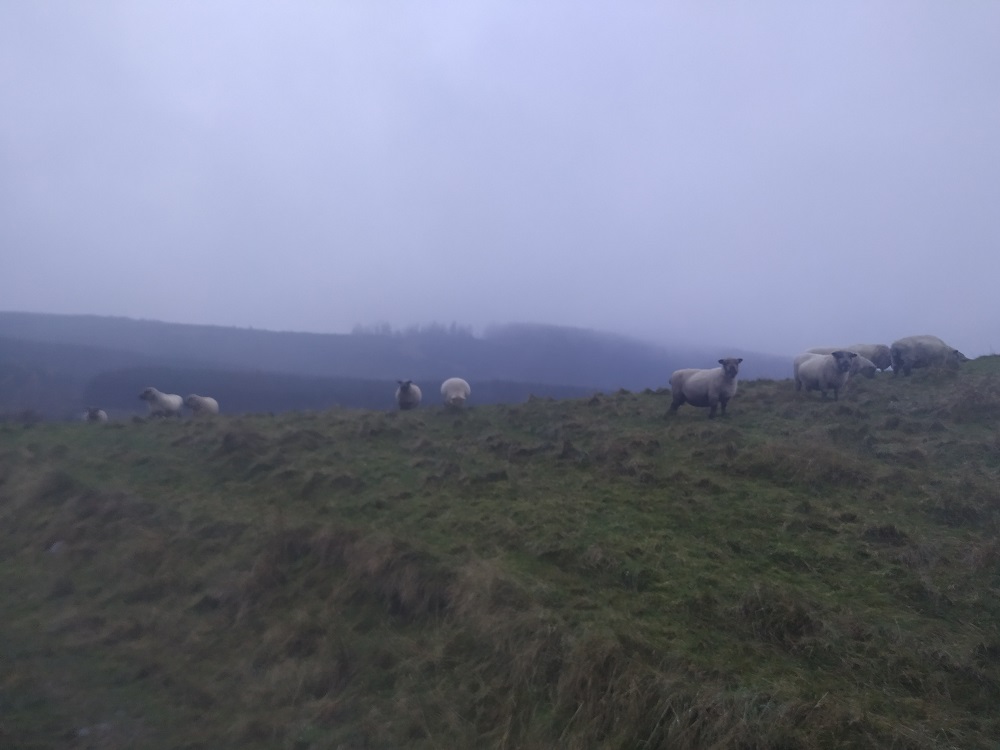
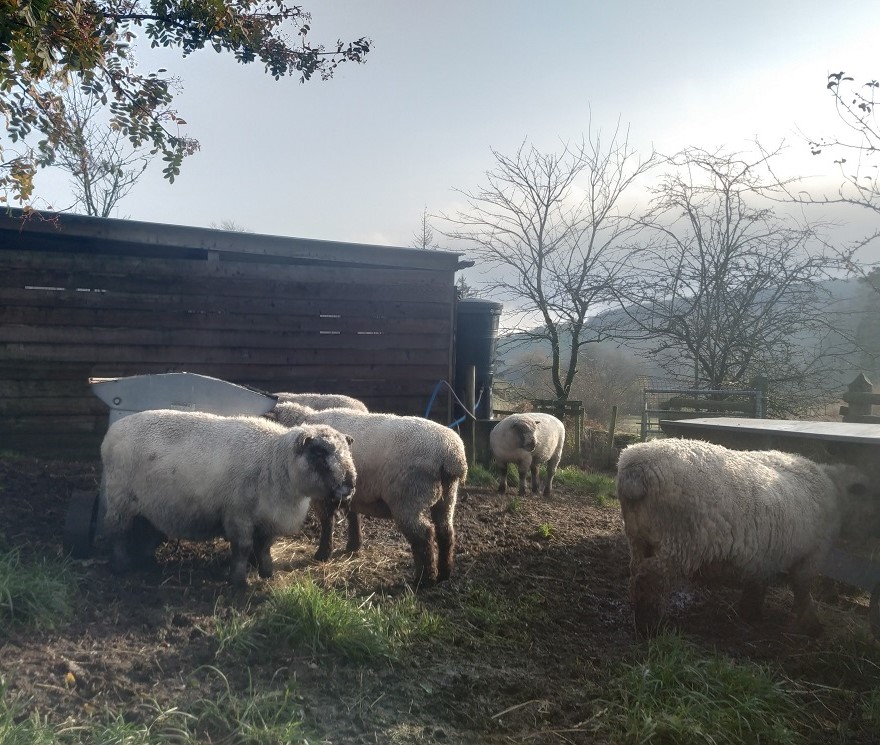
Every year, round about the beginning of November we start the “hay ceremony”.  In other words, giving the little darlings hay for the winter.  The sheep let us know when they’re ready for hay, towards the end of October they make a daily pilgrimage down to the orchard and hang around the feeders (usually when they know we’re around so they can make a point).  Sheep are clever and have their ways of communicating with us.  They do this ritual twice a day, once in the morning and once in the afternoon, just to make sure.  After hanging around and sniffing for a bit, they have a meeting and then off they go again to graze grass in the higher pastures.

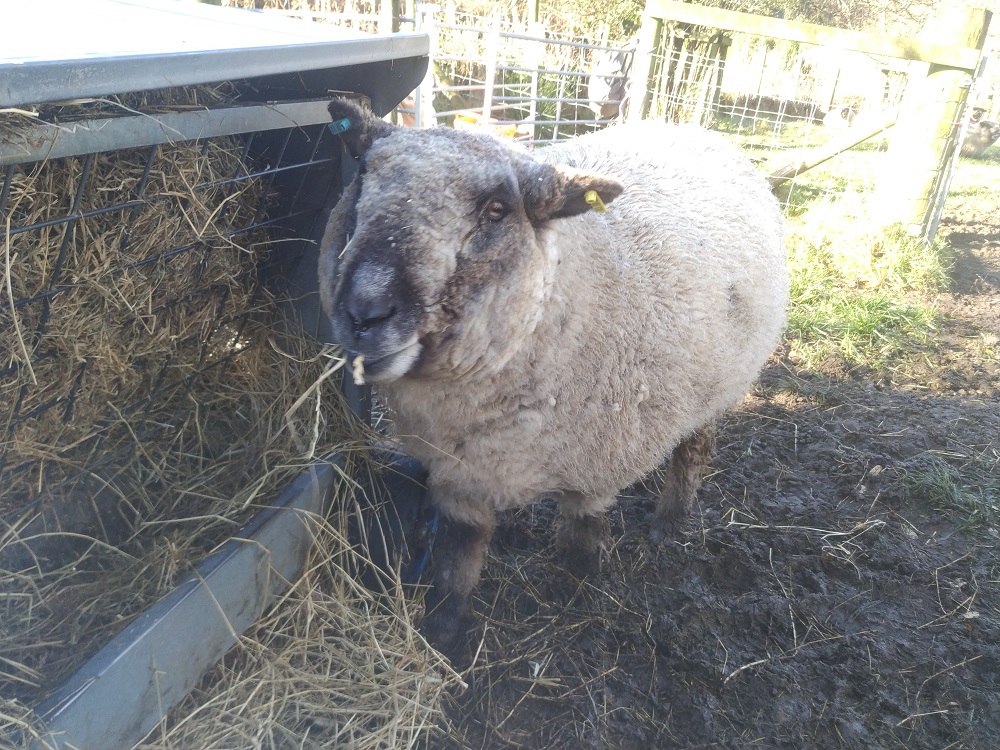
yippee!!! Hay!!!

Timing is important when it comes to hay, start the little fluffballs on it too soon and they take a few mouth-fulls and decide they’ll give the grass another chance.  This means hay is wasted because it stays in the feeders not being eaten and goes mouldy.  Start them on it too late and you have unhappy sheep.  Our sheep are lowland sheep so they need the extra forage during the winter, they wouldn’t survive without it, especially up here in Scotland.  Upland sheep and hill sheep on the other hand, (which you see a lot of around here) are much more thrifty and seemingly survive on next to nothing.

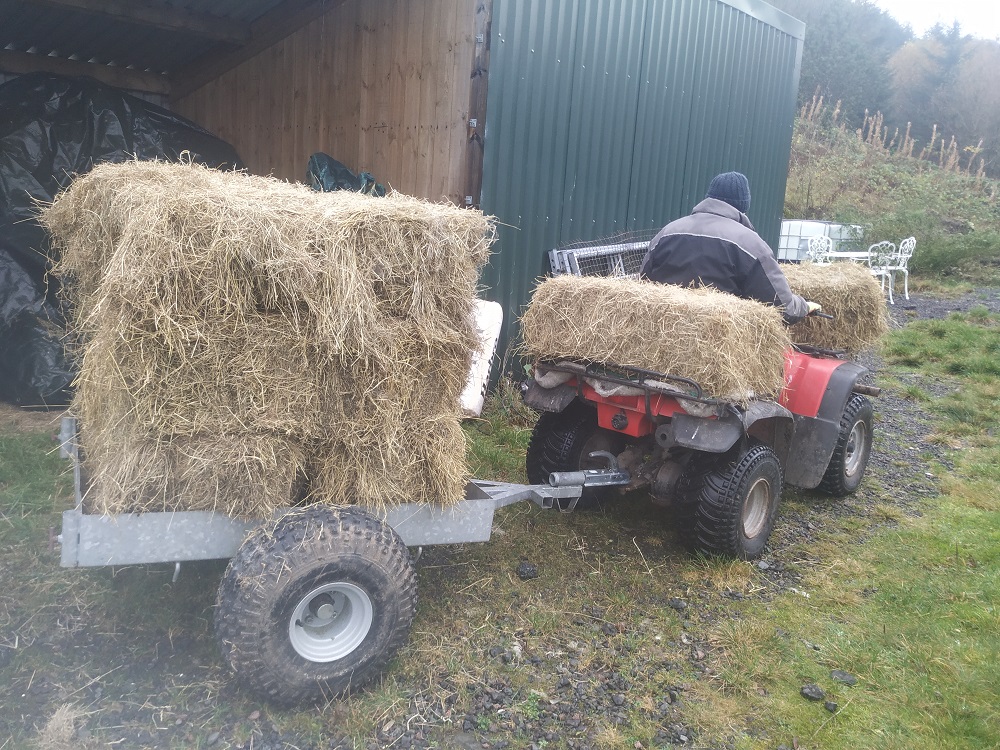
transporting hay

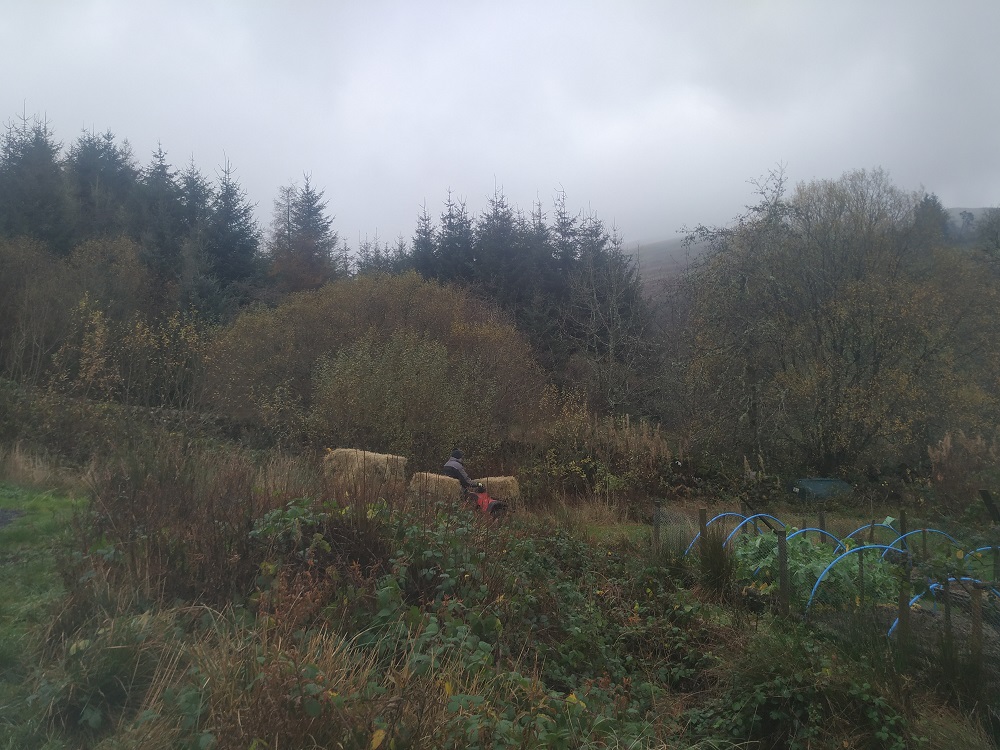
This year we started the hay ceremony last Saturday.  First of all we had to ferry bales from the big green shed down to the lambing shed in the orchard.  This started off badly because we discovered a flat tyre on our trailer.  An hour or so later after some descriptive language regarding the location of the pump, we were able to load up the trailer with hay bales and transport it down to the shed in the orchard.  After several journeys we had piled up enough hay bales to last a couple of weeks.  At the moment the sheep are on one bale a day but as winter sets in they’ll be up to two or three bales a day and then we’ll need to make more journeys.

Before that though, we’ll be heading down to the garage in the village for a new tyre for the trailer.


Posted on Leave a comment

Auchenstroan Wool & The Galloway & Southern Ayrshire Unesco Biosphere

Recently you might have noticed a new logo in the corner of our home page.  If you click on it, you will be taken into the Galloway & Southern Ayrshire Unesco Biosphere’s website.

To re-wind a bit, one sunny day back in the summer, I was enjoying a chinwag and a cuppa with my friend Kate.  We were in the Catstrand café in New Galloway (which incidentally also serves delicious cakes).

Kate works for Nature Scotland and is really plugged into the world of conservation, sustainable living and all things related to permaculture, particularly farming.  Kate and I always have a giggle and great chats whenever we get together.

Whilst putting the world to rights over our cups of tea, Kate asked if I had heard of an organisation called the Galloway & Southern Ayrshire Biosphere.  I said it rang a bell but I wasn’t sure what they did exactly.  (I should probably get out more!)  Kate filled me in and said it might be worth me getting in touch as we, (my woolly business) was just the sort of thing the Biosphere were interested in.  Part of the Biosphere’s work is to promote small, sustainable businesses.

I decided to apply to become a “Proud Supporter” with a view to becoming “Biosphere Certified”.  I clicked on the relevant buttons on the website and up popped a load of forms to fill in.  I’m fortunate to be married to a man who is a whizz at form filling so I roped Hubs in to help me and by the end of the day we had clicked through the pages and sent everything off to be processed.

Last week, out of the blue I received an email from the Biosphere team and saw that happily my application had been successful!

Soon, one of the team will come up to meet us and look at what we do here on our smallholding.  We are very much looking forward to showing them around, introducing them to our animals and chatting about what we do here.

Posted on Leave a comment

Splish Splash

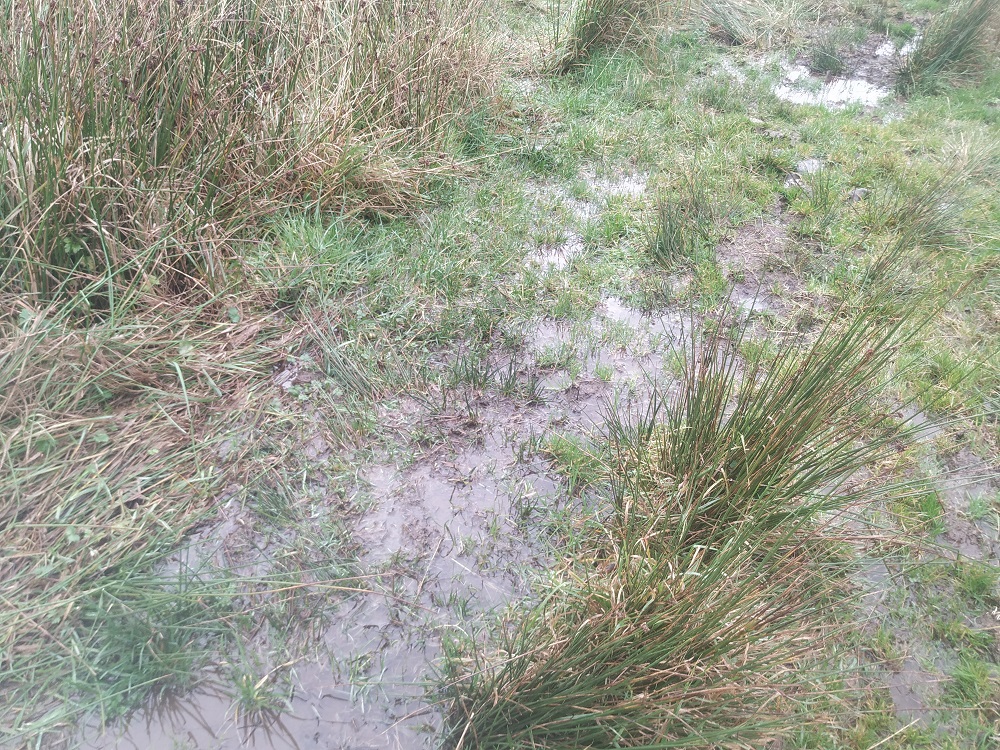
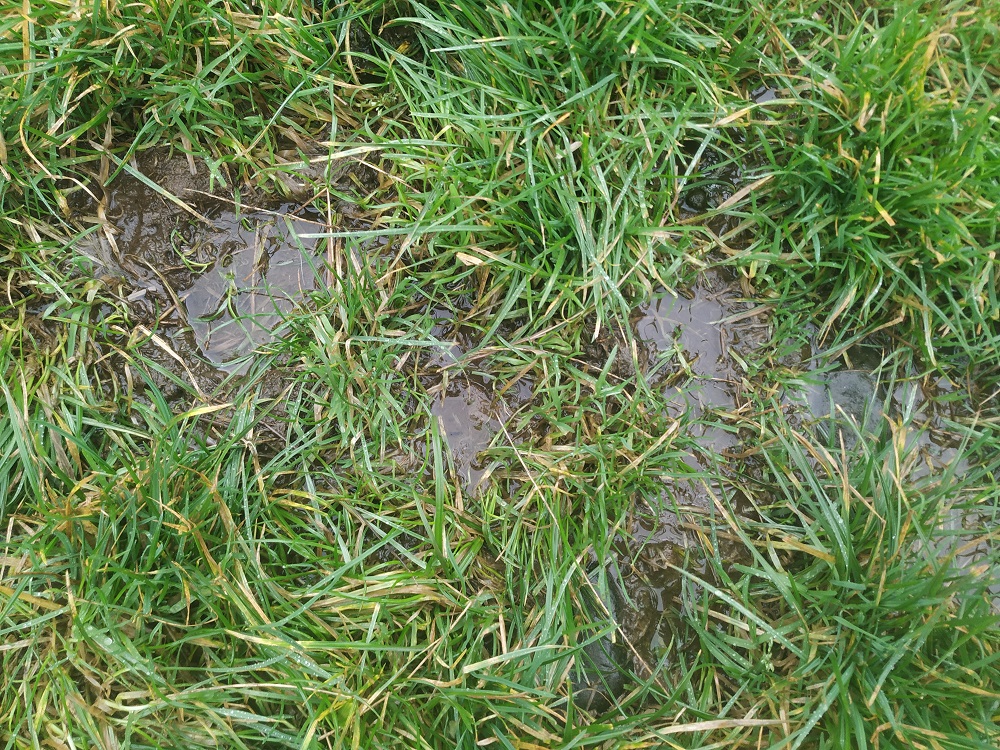
It has not been the driest of summers which has had it’s good and bad points. However, it has been one of the wettest of Octobers I can remember. Someone turned the rain tap on and has forgotten to turn it off again.

more puddlesThe ground has been turned from firm grassland into puddles. This is particularly true of the flatter areas where water settles having flowed down the hill. Sadly, there’s not much we can do about it except hope for some dry weather to give it all a chance to drain.

puddlesIt’s not great for the animals. The hens gather and huddle in their shelters, trying to keep dry. The sheep venture out to find grass (plenty of that), but retire to dry off in one of their field shelters.

We’re having to keep a close eye on the sheep’s hooves, checking for signs of foot rot which can flare up in these conditions.

And autumn planting of garlic has been postpones lest the bulbs float away.

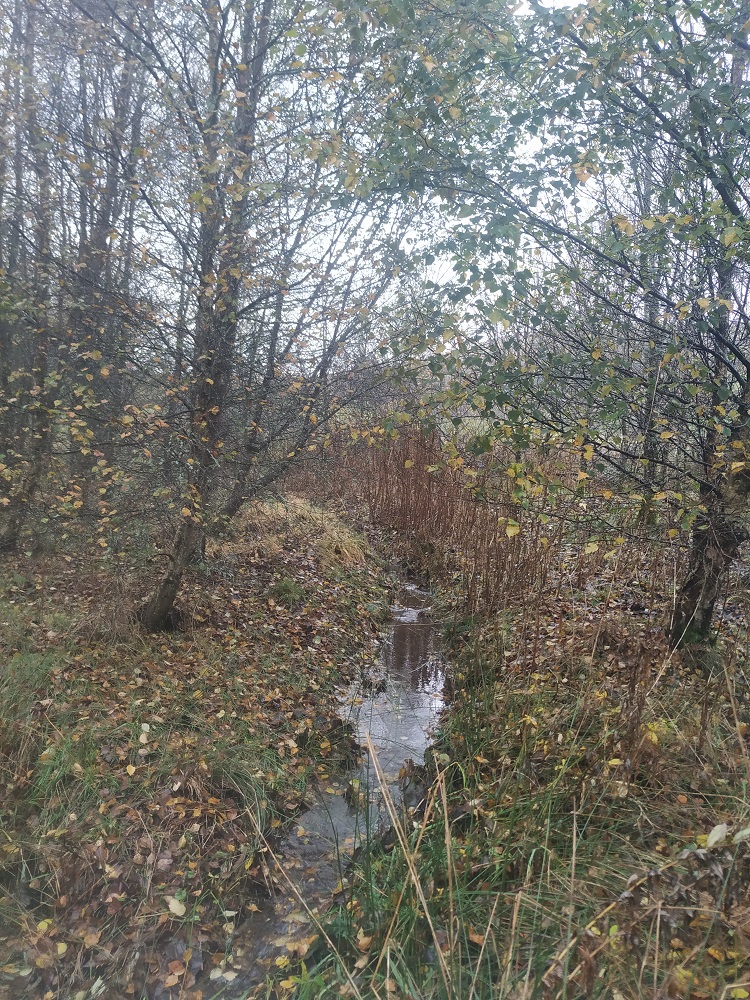
In the woodland, the drainage ditches are full but doing their job. Anyway, that’s the way it is in SW Scotland, either too much water or too little.

Thank heavens for wellie boots :).

woodland in autumn
woodland in autumn
Posted on Leave a comment

Autumn mulching

Today while I was in the polytunnel having a tidy up, I became aware of some strange noises coming from outside.  It sounded like pigs scoffing their way through a pile of apples and bananas.  I wondered if Adrian had got me an early birthday present.  There were snuffles and grunts interspersed by a strange high pitched creak.  I stuck my head out to investigate,  the noises seemed to be coming from the direction of the veggie patch.  There was also a sheepie-smell drifting around which I couldn’t quite place but seemed familiar.

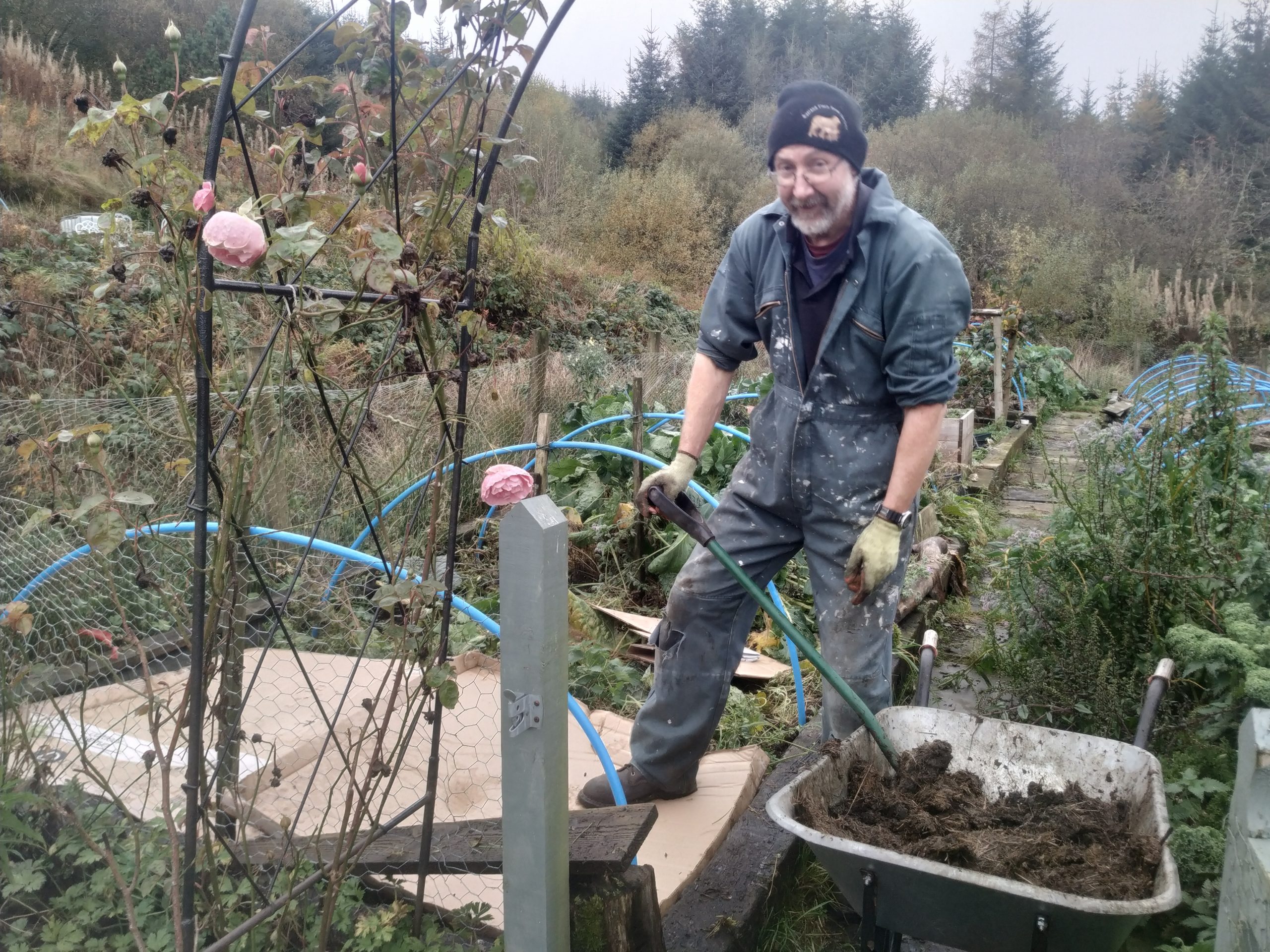
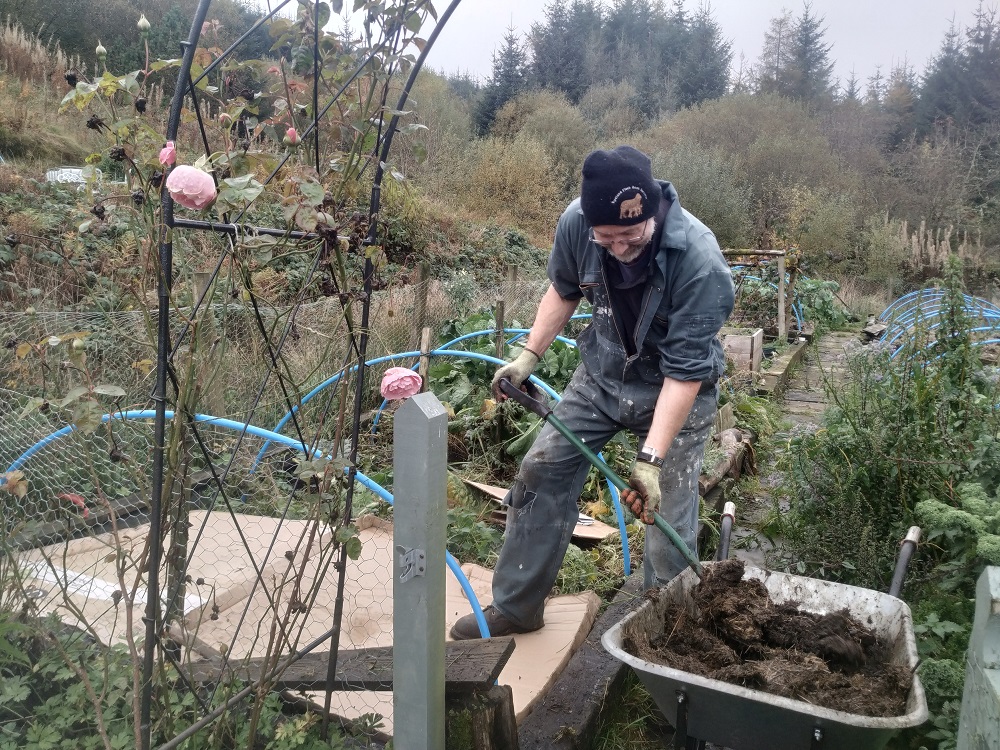
Looking over at the veggie patch I spotted a huge wheelbarrow filled to the brim with manure trundling down the path going “creak, creak, creak”.  Behind the barrow emerged Adrian going “grunt, ah, ooh, aaa”.  Atop the barrow like a cherry on a cake was a pitch fork.

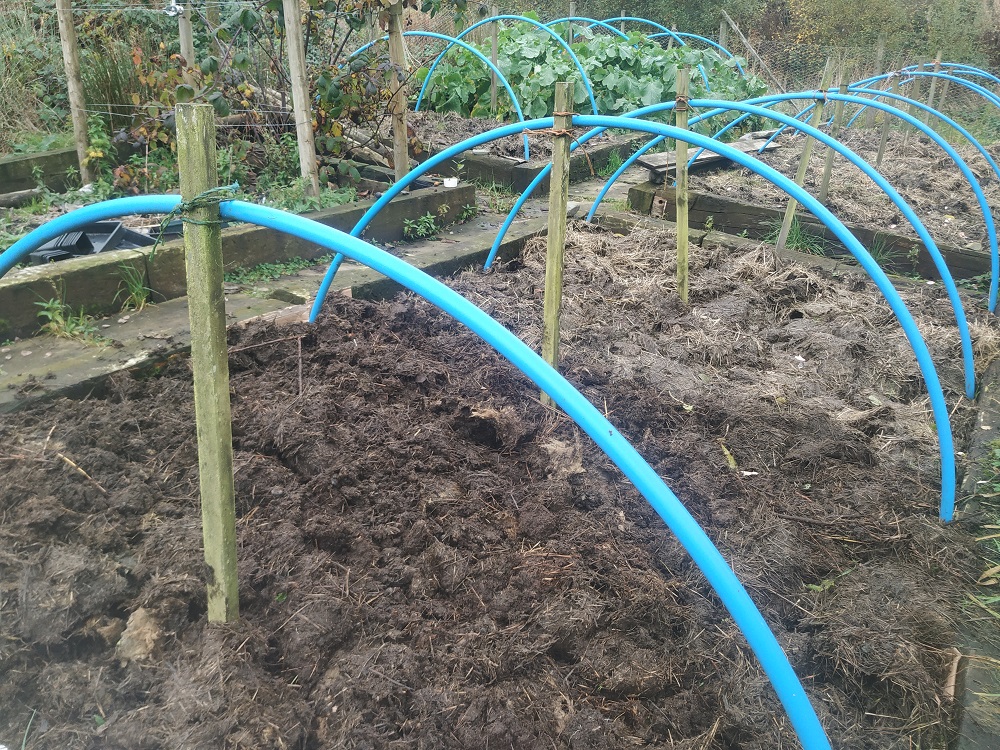
mulching the dormant beds

Then I remembered, this week is mulching week!

Mulching week entails something we do regularly here, shifting dung from one place to another.  In the case of mulching, this means shovelling well rotted sheep dung from the manure heap, over to the veggie beds.  This is done using a pitchfork, a large wheelbarrow, muscle power and lots of huffing and puffing.

glorious sheep dung

Our veggies love a good mulching, the soil has improved a million-fold since we started piling on the dung every autumn.  When we created our veggie patch five years ago, the soil was in a terrible state, all claggy and compacted.  We think there might have been a structure at some point in the history of the farm, where the veggie patch now is because the soil was so compacted and there was a ridiculous amount of rocks just below the surface.  Mind you, that is normal around here!

Fast forward five years and the soil is crumbly and lovely to work with.  The veggies are happy and thriving, and so are the slugs, but that is another story for another day.


Posted on Leave a comment

Elliot can now be with the hens

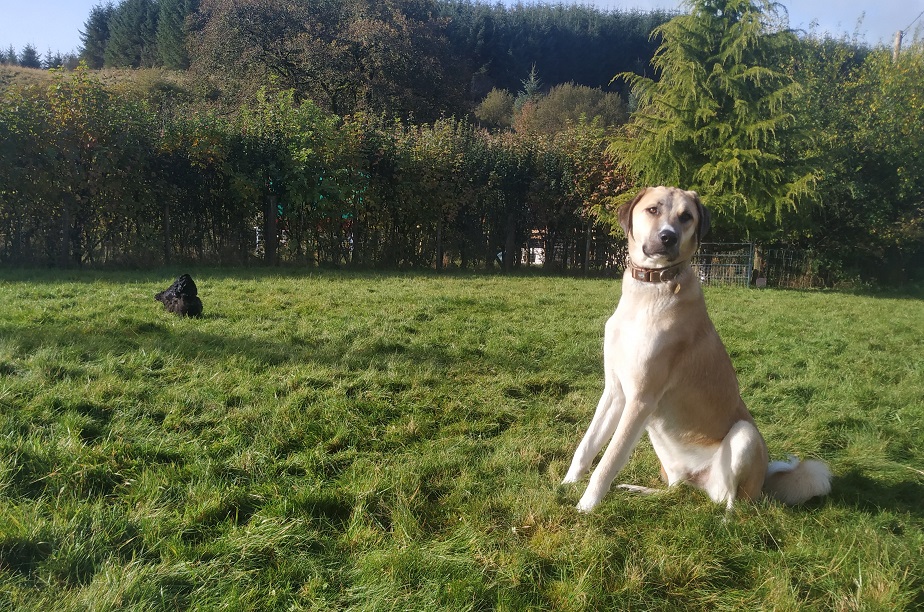
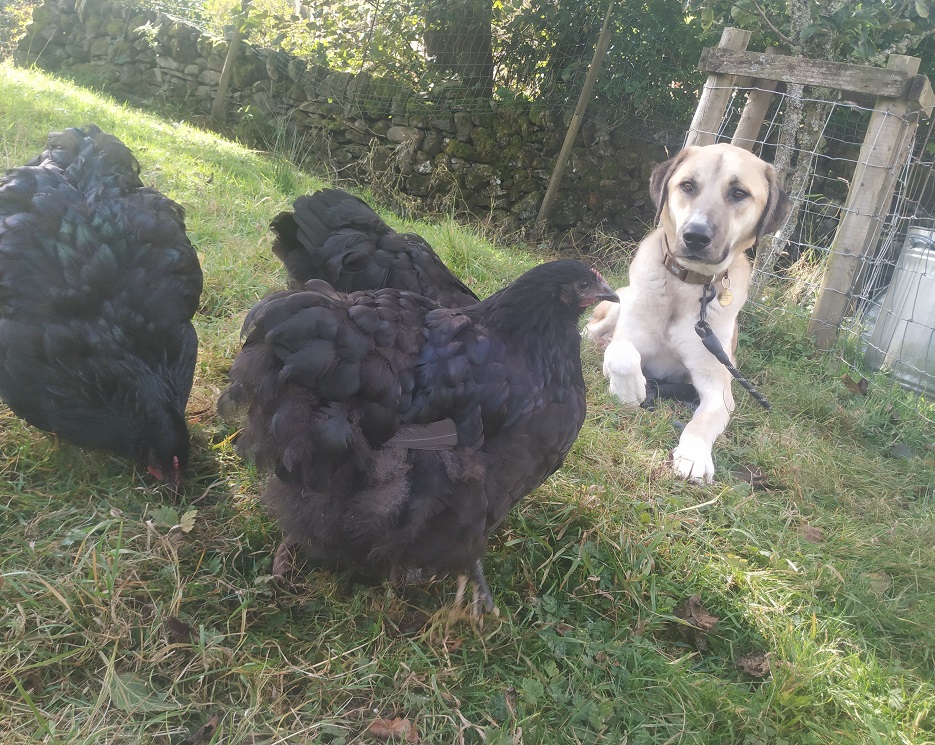
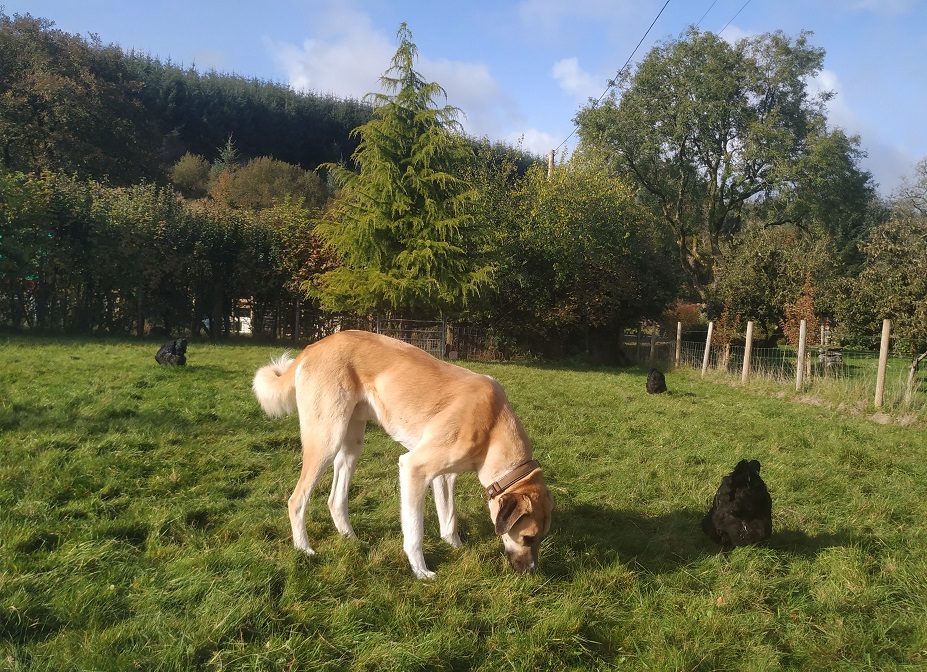
After three months of slowly introducing Elliot to the hens, yesterday was a big day for our Anatolian rescue dog from Turkey.  Elliot was ready to be let off lead amongst the hens!

Elliot and the chicks

We took lots of time with the “hen training” because Elliot didn’t get off to a good start with our feathered friends.  He had Clippy in her mouth during his first week here so both the hens and Elliot had to re-learn how to be with each other.  Elliot showed a little too much of the wrong kind of interest in the hens and the hens were nervous and panicky when he was around.  Not handled correctly, the training could go badly wrong.  We knew it would take time but by the same token we were hopeful it would be possible.  The truth was, we didn’t have much choice as with winter approaching we would soon have our hands full with feeding the sheep their daily hay.  The hay feeders are situated in the orchard where the hens are and we wouldn’t be able to have Elliot on his lead whilst sorting out the hay.  There’s too much to do so Elliot would need to be ready to roam free with the flock by the end of October.

just hanging out with my new pals

The training itself was quite tedious, you can read more about it here.  This said, the hens loved it because they got extra corn.  Most of the time George (our other dog) was visibly bored by our daily trips to the orchard.  He made a point of sitting by the gate so he could make a swift exit when the training was over.  Happily, despite his reluctance to get involved, his presence still had an effect and Elliot learned to relax more and “just be” with the hens with each passing day.  Animals learn best from each other and so far George has been a good teacher to him (even if some of his lessons are not necessarily to our benefit, ie, on hearing the recall command, decide in your own time whether it’s worth going back or not) …

Although Elliot can now be around the hens off lead, we will continue to keep a close eye on him over the next few weeks.  If anything were to trigger either the hens, the sheep or the dogs into an excited state, (ie a cat appearing out of nowhere), then we’d need to make sure he would be able to handle this and not get caught up in the high energy.

We will see how he goes over the next few weeks but so far so good, well done Elliot!


Posted on Leave a comment

Sharing the love of wool with the wider world.

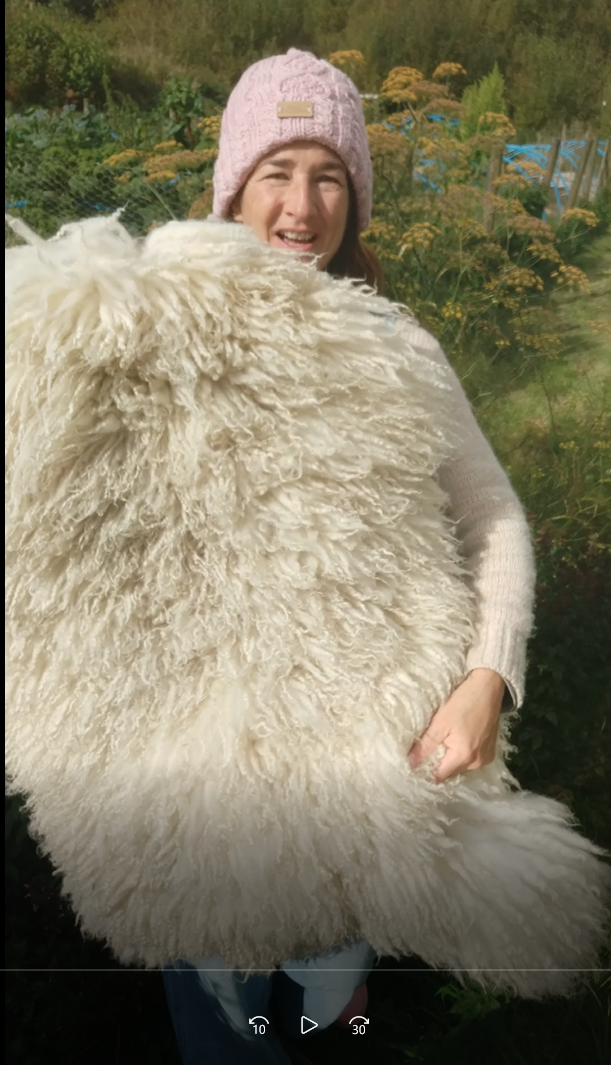
Today’s blog story is to tell you about my rug-making teaching adventures over the summer and about the new downloadable instructions I’ve created on how to make felted fleece rugs.

I’ve been thinking about running rug-making workshops here on our smallholding for a few years now.  Then Covid happened and my plans went on hold.  Truth be told, I didn’t mind too much as the thought of all the spiders I would have to face while clearing out the shed was quite daunting.

relaxation area

I would need a lot of room, particularly as part of my vision was to include an area for a table and chairs for participants to relax and enjoy tea, coffee and biscuits in between felting – very important for any workshop, especially a whole-day one involving loads of physical effort.  All the room I would need would take a huge effort and reorganization of tools and equipment.

I’m happy to say I managed it!  (Admittedly with a lot of help from Adrian, my personal “Chief (humane) Spider Remover”).  And this summer the workshops became a reality.

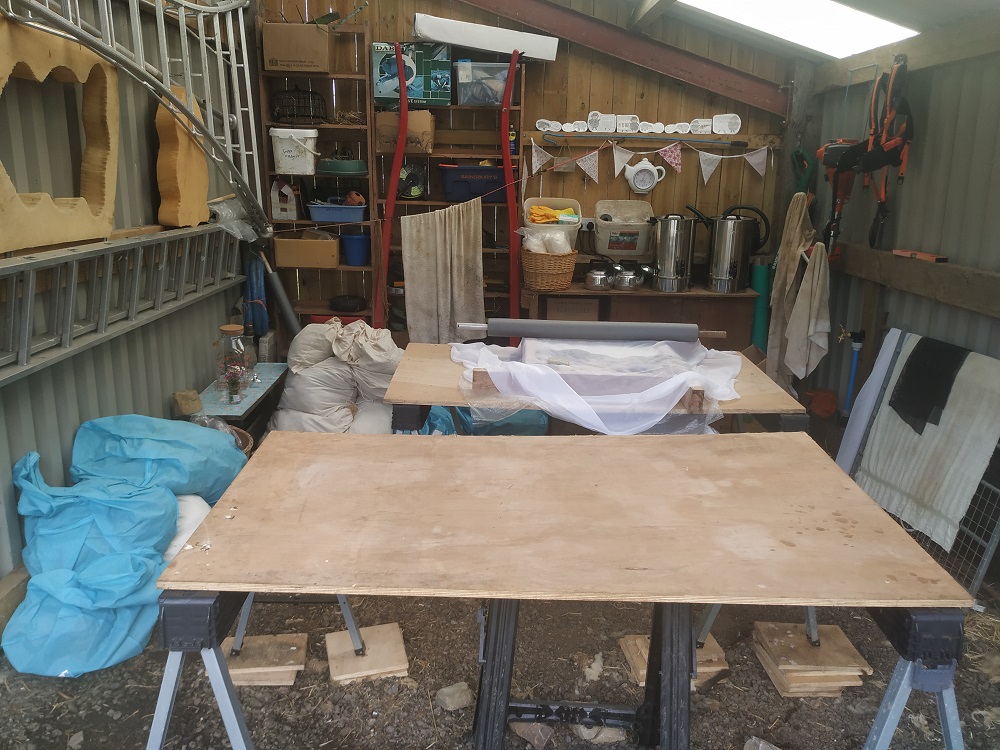
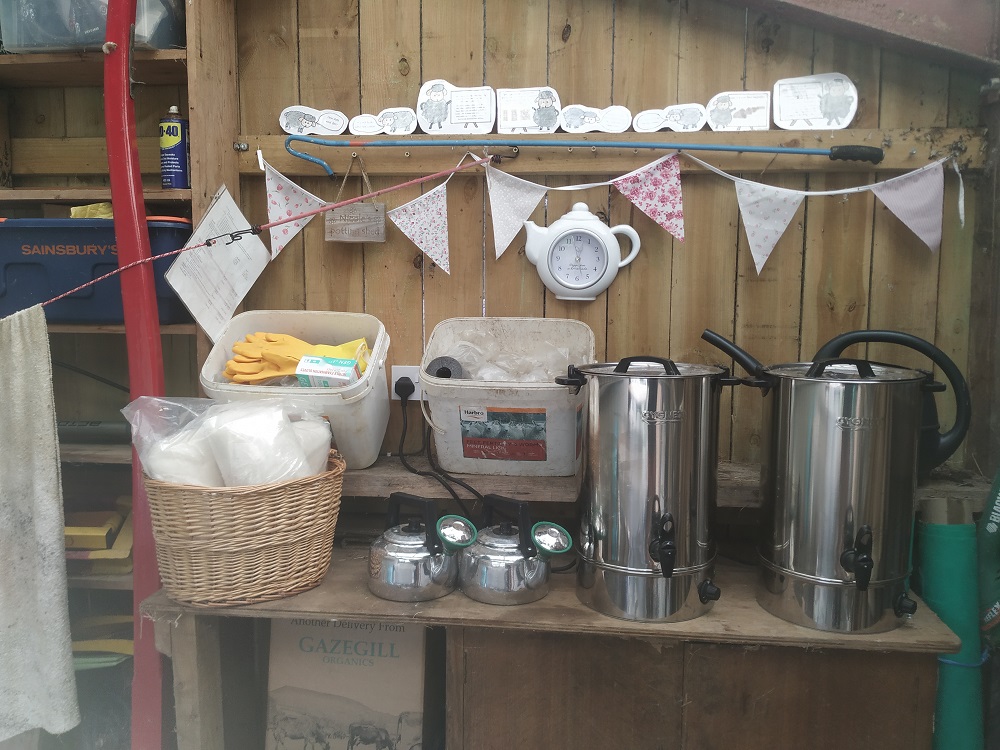
The shed was transformed into a teaching room complete with large tables for felting and shelves for wool, towels, bars of soap and hot water urns.  The spiders moved next door, they said they weren’t keen the disturbance and preferred the peace and quiet of the hay shed.

Over the last few months, as well as teaching here on site and meeting some really inspiring and creative people, I’ve also updated my original (face up method) “downloadable rug making instructions”.

In addition to this, I’ve also created a brand-new set of downloadable instructions (face down method) so there are now two to choose from.

where the action happens

You’d be right in thinking I’m on a mission to spread the love of wool 😊

For those of you who know a little bit about making felted fleece rugs, you’ll probably be aware there are two ways to make them.  There is the “face up method” which is brilliant if you’re new to rug making as it’s slow and methodical.  It’s also ideal if you have a fleece which is in bits but you still want to use the wool.  It’s a time-consuming method but a lovely, meditative way to work.

Then there’s the “face down method” which is a little quicker than the above method, but you need a fleece which holds itself together well and isn’t likely to fall apart at the slightest puff of wind.  This method can be somewhat daunting if you’re new to rug making as you’re working upside down.  (Not you, the fleece).

If you’re interested in making your own rugs and creating something unique and beautiful for your own home, I can’t recommend it enough, just dive in and give it a go!  You can buy raw fleeces from ebay and etsy or better still, direct from a farm.  Click on the links below to find out more about learning this wonderful craft:

shelves full of felting things

Workshops here on our smallholding

Downloadable instructions:  making a felted fleece rug the face down method.

Downloadable instructions:  making a felted fleece rug the face up method.


Posted on Leave a comment

Harvest Time

The harvest rush has been on in the last week. We already had collected what was left of the beetroot (see beetroot bother), but other fruit and veg were ready and needed picked before the pesky slugs had those too. The only things that seem to be safe are the tomatoes (polytunnel too dry for them) and the carrots (special anti-slug box works a treat).

In the last week, we’ve harvested the apples, onions and cabbage. That leaves the sprouts (what’s left of them), broccoli (which will be ready next year) and turnips (haven’t dared look).

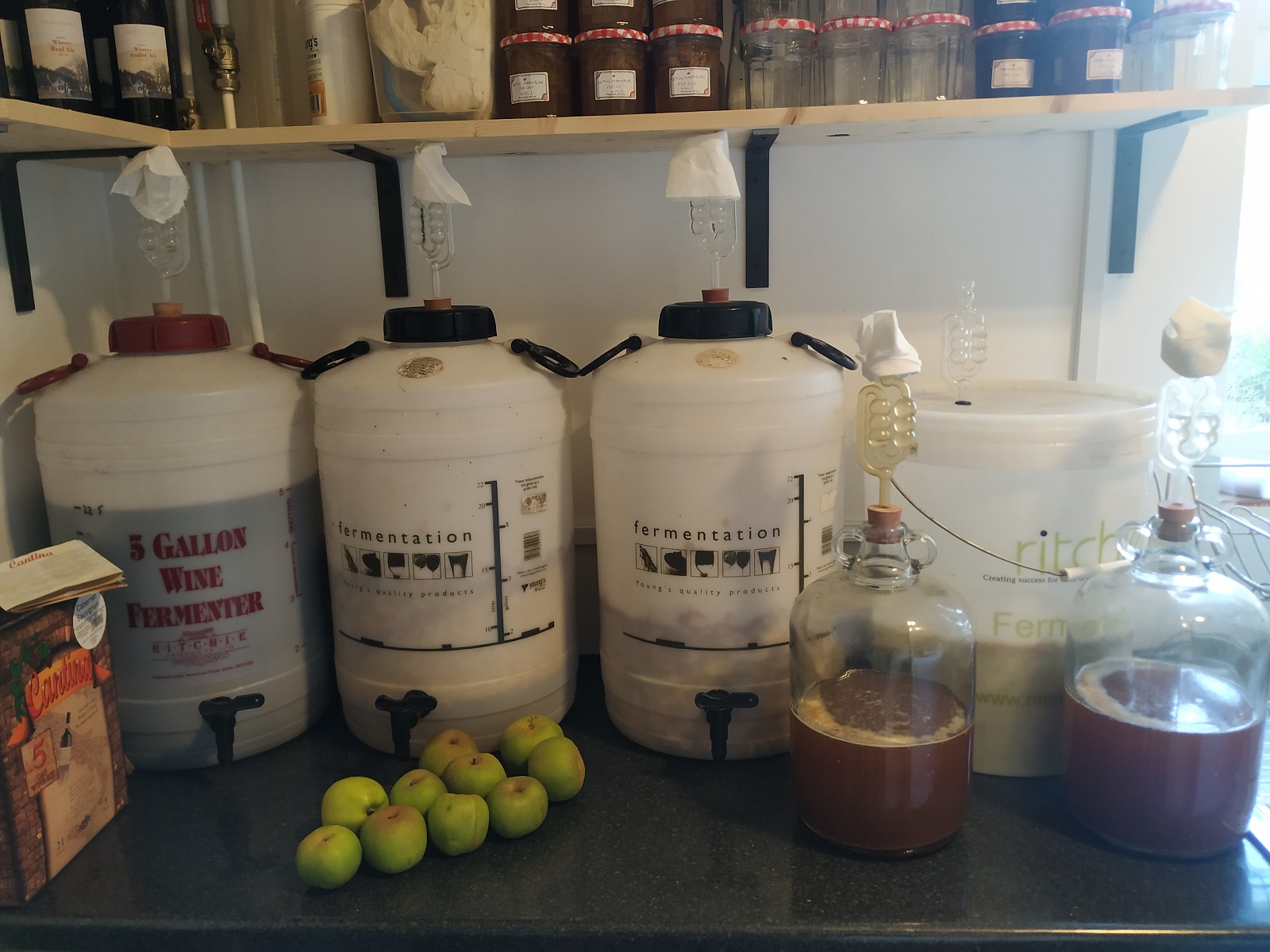
Left to right – red wine, cider vinegar (x2), sauerkraut behind 2 x cider

We got a good harvest of apples this year. The best have been set aside for eating, the rest converted into cider vinegar, cider and frozen apples for winter roasts. We got the cider press up and running this year (only taken 5 years), so got some apple juice. We got 5 litres to be exact and all is being made into cider. The eagle eyed among you might be wondering why I have split it across 2 x five litre demijohns. Well, it did all fit into one, but in my experience, wild fruit can be pretty vigorous in the fermentation process and has been known to spray the walls. Of course, nothing has happened yet as the temperature has dropped a bit and the yeast is shivering rather than getting on with it.

There are still a few late developing apples on the trees. Hopefully, they’ll be fine for eating as they come.

We also harvested all the cabbage. That, in itself, removed an army of slugs from the veggie patch. All leaves were examined carefully and any wildlife removed before the cabbage was shredded. Salt was added, massaged in and now that is also fermenting quietly. Should be ready in 3 or 4 weeks.

All takes time, but very satisfying once it’s done.


Posted on Leave a comment

Moving the Hens – Part 2

hen central - omlet walk in run complete

Carrying on from last week’s story, Moving the Hens, we have both been busy installing and preparing the new area for the chicken coops. We call this ‘Hen Central’ because it’s where they eat, drink, sleep and lay their eggs. The big jobs this week were to install two new fences and put up a walk in run.

hen central - old gate
hen central – old gate, new stob already in place

The first new fence is where the old entrance used to be. There was a fence there, but it was only chicken wire. Given it was along the track, this is where the biggest threat from unsupervised dogs was to be found. The gate was removed and proper stock fencing put up. Not 100% dog proof, but far stronger.

The second new fence is in the orchard which doubles as the hen run. It is needed not to keep the hens in, but the sheep out. Sheep have a penchant for scratching themselves on any available object, so they could do a lot of damage. They also are partial to corn, so would be tempted to get into the feed bins. Plus, the hens need somewhere where they can have a bit of peace and quiet.

Also, if a hen goes broody, we need to be able to set aside a space for the nursery run and an area for them to wander out and about, free from the danger of sheep’s hooves.

The walk in run is more to deter night time threats and also, prevent wild camping. The plan is, at roosting time, to tempt them into the run and shut the door. That way, the hens’ only option is to sleep in the safe chicken coops.

bye bye electric fence

We ordered the Omlet Walk-in Run and it was earmarked for delivery on Tuesday. So, I got started on the deconstruction of the old hen central. First to go was the anti-badger electric fence. It had done it’s job, but was no longer needed. It would also no longer be a trap for the unwary, easy to trip over.

Next was the first of the two fences. That was fairly straightforward as most of the stobs were already in place.

Come Tuesday, no delivery date was available from DHL so I got on with the second fence. That was soon up complete with purpose built hen flaps.

hen central - new gate and fence
hen central – new gate and fence

Wednesday came and still no run or delivery date. I attempted to decipher the jumbled misinformation on the DHL tracking service and worked out that 13 of 14 parcels had been forwarded from the Glasgow depot to the local delivery agent. One was missing. Of course, modern customer service comprises the above misinformation and a chatbot that is worse than useless. We contacted Omlet to see if they could find out any more. They, too, struggled to get any meaningful information from DHL.

hen central - boxes opened omlet chicken run
hen central – boxes opened

Anyway, Thursday arrived and Nicole and I carried on and got as much of the new run ready as we could. The fences and new gate were in and all the shelters and feeders were laid out in their new locations. Thursday afternoon, still no news from DHL. Without warning, a van pulled up and disgorged 14 packages. It had arrived! DHL were kind enough to send an email to let us know it had been delivered.

hen central - level one omlet chicken run
hen central – level one underway

Friday, our day off, so to speak. Normally we take the dogs and a picnic and head off somewhere for a break. Not today. I got started on the new run. First off, I had to build a small bank as, at one corner, the land slipped away quite steeply. This meant transporting a fair few stones and some road scalpings. No sooner had I finished that than Mrs Mills Junior began to dismantle it. I gently persuaded her to move on and retired to ponder the Omlet instructions. An hour later, I felt ready to begin.

I have built a few Omlet runs in the past so was aware of the clip system they use. However, nothing had prepared me for the new ‘double-clip’ used in certain places. It needed about 20 tons of pressure to close it. I have to confess to employing some choice language. Finally, I worked out a technique I could use.

hen central - omlet walk in run complete
hen central – omlet walk in run complete

It’s not a one person job. Nicole pitched in to help and we worked non-stop till we had it built. We were both loudly cursing the Omlet plastic clip on by the end of it. We were both completely shattered when we finished some time around 6pm. We were delighted with the result, the run looked excellent. Cherokee, the cockerel was already hovering as he likes to get to bed early. But, he’s pretty cool and waited patiently. The moment we stepped out of the run, he stepped in and went to bed.

Seizing our opportunity, Nicole threw some rice and corn into the new run. All but two hens rushed in. Pepper and one of the youngsters (still to be named) decided to run round the outside instead. With deft care and precision, I coaxed them round to the front where Nicole was managing the door. To our relief, they crossed the threshold and we shut the door behind them. The hens were safe and happy. We had turned a two hour vigil into a five minute gathering. Wine and beer called, it was time for a celebration.

Then we counted them.

One short – who else but Mrs Mills Junior? Nicole arranged the search party and located her at the far end of the paddock having a dust bath. Gently, she was persuaded all the way back and, in another dance of co-ordinated movements, she was herded through the door.

Now we could celebrate.

Later on, when they were all tucked up in bed and the doors to their coops closed, Nicole opened the door to the run so they could get out in the morning. My next job will be to install an automatic door. We have the door motor, I just have to build a panel. Once that’s in place, we can leave the run securely closed at night and the door will open automatically for them in the morning.

Over the coming days, the goal is to train them to go into the run just before bed time. Hopefully, in time, they’ll forget about sleeping in the bushes.

hen central - view from the orchard
hen central – view from the orchard